


Blog
Does a 25mm Cartridge Really Save Water: Clarifying Flow Rate, Water Pressure, and European Sourcing Standards All at Once
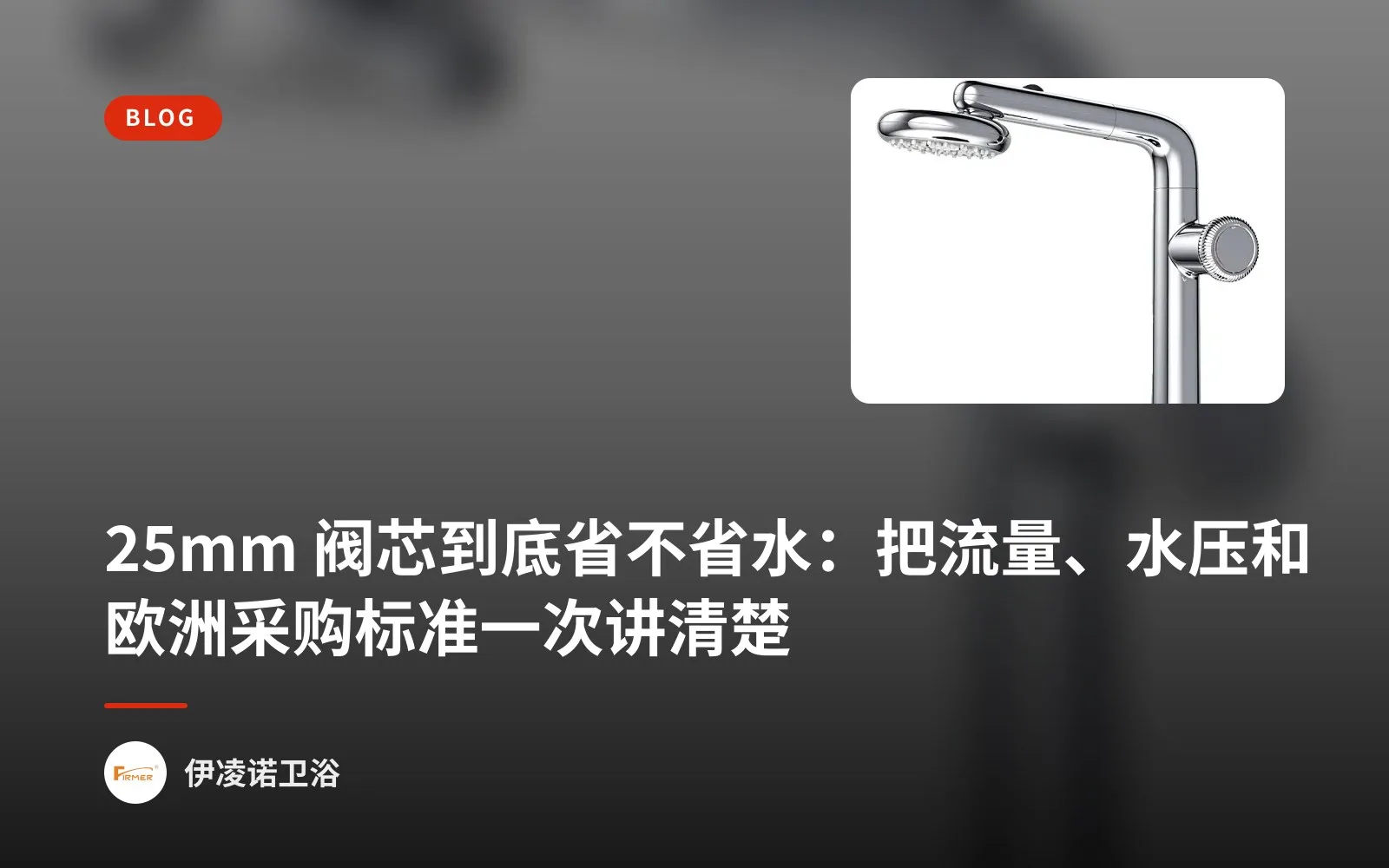
When choosing a faucet, most people first look at the shape and surface finish, and check the cartridge last. However, what truly determines the water experience and whether it can pass European flow rate thresholds is the cartridge.
Why Cartridge Diameter Directly Determines Flow Rate
From the water inlet to the outlet, the first bottleneck is the cartridge's internal bore diameter. The bore of a 30mm cartridge is one grade larger than that of a 25mm one. Calculated by area, the flow cross-section is proportional to the square of the diameter; a 25mm cartridge has about 30% less flow area compared to a 30mm one. Therefore, under the same water pressure, the water flow from a 30mm cartridge is more forceful.
How Big Is the Measured Difference?
Under 0.3 MPa conditions, the actual flow rate data for the two cartridges are as follows:
25mm cartridge: 6–7.5 L/min
30mm cartridge: 15–16 L/min
This reduction is actually greater than the 30% cross-sectional difference. This shows that flow restriction does not occur only at the cartridge; other structures at the outlet end also work together to control the flow velocity. For buyers, the key is not to dismantle the structure, but to remember one thing: faucets with 25mm systems generally have a flow rate in the 6–8 L/min range, while 30mm systems are around 15 L/min.
Does Saving Water Mean Ineffective Cleaning?
This is the question buyers ask most frequently. The judgment criterion should be "cleaning effectiveness per unit time," not just "total water output." Actions such as washing the face, filling water, and soaping hands require water stream coverage and rinsing force, not a bulky water column. A 25mm cartridge paired with an aerated stream produces a softer, more evenly dispersed flow, so in actual use there is no feeling that "water flow is too small to clean properly." What truly suffers from low flow is scenarios requiring impact force, like shower heads; however, showers use a different waterway and are not on the same line as the cartridge bore.
Currently, the main shipment volume for 25mm cartridge solutions is approximately 10,000 sets per month, mainly heading to the UK, Italy, France, and the UAE.
Water Pressure and Lifespan: Two Easily Overlooked Margins
Pipeline pressure limit of 16 bar. Municipal water supply in most countries and regions is 3–6 bar; 16 bar is a safety margin for project acceptance and extreme water hammer conditions, not daily operating pressure.
500,000 switching cycles of cartridge durability. Estimating 30 switches per day for a family of three, this durability corresponds to a service life of over forty years. For high-frequency usage scenarios such as commercial projects and hotels, this number is far more important than a "smooth feel."
Practical Advice for Buyers
Selling to Europe and Australia: Prioritize models based on 25mm cartridges; clear the flow rate hurdle first before discussing appearance
Selling to North America: Note that cUPC certification is issued per specific model; changing the cartridge equals changing the model, and the certificate must be updated accordingly
Selling to the Middle East: Water pressure fluctuates significantly; verify the 16 bar pressure margin first, then check local certifications (SASO)
Commercial project orders: Specifying "cartridge brand and durability cycles" in technical terms is far more useful than writing "high-quality cartridge"
Frequently Asked Questions
Q: Can a 25mm cartridge be installed in all faucets?
A: No. The cartridge bore and the faucet body's waterway share an integrated design. Changing the cartridge means changing the entire waterway; you can only choose according to the model, not modify it afterwards.
Q: Could 6 L/min fall below the legal minimum in some countries?
A: Some national standards also have requirements for minimum flow rates (for example, kitchen faucets need to fill containers faster). Therefore, the same brand will maintain both 25mm and 30mm product lines, configured according to the target market.
Q: Why do you produce both 25mm and 30mm?
A: Because water efficiency standards vary across different markets, and manufacturing only one line would mean losing half of the orders.
