




Blog
Haima Super Interview Episode 12 | How Cross-Border Enterprises Address Compliance Challenges Under Different Legal Systems
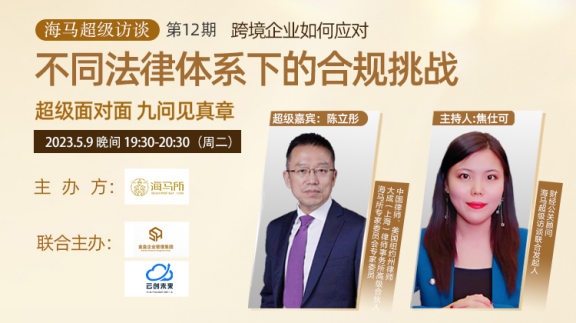
Produced by: Haima Institute
Edited by: Xiaojin
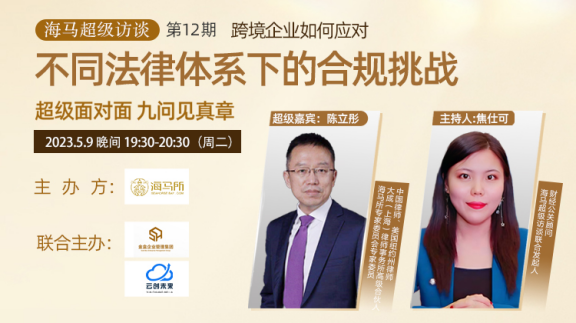

About Haima Super Interview
Haima Super Interview is jointly launched by "Cloud Creation Future Master Lecture Hall" and Jinhe Enterprise Management Group, aiming to explore the insights of successful entrepreneurs, experts and scholars in business operations and commercial practices.
With the vigorous development of the global economy and the intensification of global market competition, all walks of life are facing complex laws, regulations and compliance requirements. Compliance risks not only pose potential threats to business operations, but may also affect corporate reputation and sustainable development.
On May 9, 2023, the 12th episode of Haima Super Interview: How Cross-Border Enterprises Cope with Compliance Challenges Under Different Legal Systems? online live stream, co-hosted by Haima Institute, Cloud Creation Future and Jinhe Enterprise Management Group, was held as scheduled.
This episode specially invited Chen Litong, expert member of the Expert Committee of Haima Institute and senior partner of Dentons (Shanghai) Law Firm, to the Haima Super Interview live studio, sharing with everyone the compliance challenges and response methods faced by cross-border enterprises under different legal systems, in-depth discussing the importance of compliance for enterprises, and sharing Mr. Chen's best practices in cross-border enterprise compliance.
Without further ado, let's check out the key takeaways!
(Follow our WeChat official account to book Haima Super Interview online live streams!)
Chen Litong Special Guest of This Episode
Expert Member of the Haima Expert Committee
Senior Partner of Dacheng (Shanghai) Law Firm
Chinese Lawyer, Lawyer of the State of New York, USA
Former Asia-Pacific Compliance Director of Ford Motor Company
Former Special Compliance Officer of a well-known NASDAQ-listed company
Author of "Outbreak and Prevention of Compliance Risks in the Process of Enterprise Internationalization" and "Practical Guide for Chief Compliance Officers and Enterprise Compliance Officers"
Jiao Shike Host
Co-founder of Haima Super Interview
Financial PR Consultant
Veteran Financial Journalist
Previously worked at well-known investment institutions and financial media, and has produced multiple industry research reports.
Highlights Review
Super Face-to-Face: Nine Questions Reveal the Truth
1
First Question
Host - Jiao Shike:
Why do Chinese enterprises trigger multiple risks in the process of internationalization?
Guest - Lawyer Chen Litong:
In fact, not only Chinese companies will encounter many risks when going abroad, but foreign companies will also encounter many risks when coming to China.
Why is this?
It's like people - if you eat five grains, you will inevitably get sick, grow old and die. In English, a joint venture is called "Joint Ventures", which means taking risks together. So as long as you run a business, there will be risks, you can't escape them.
Why might enterprises face more risks when going overseas?
Because when enterprises go to unfamiliar places, with unfamiliar legal and regulatory environments, language barriers, and many enterprises are reluctant to spend money on hiring lawyers, always feeling that relevant risks are far away. These factors combined amplify the risks when enterprises go global.
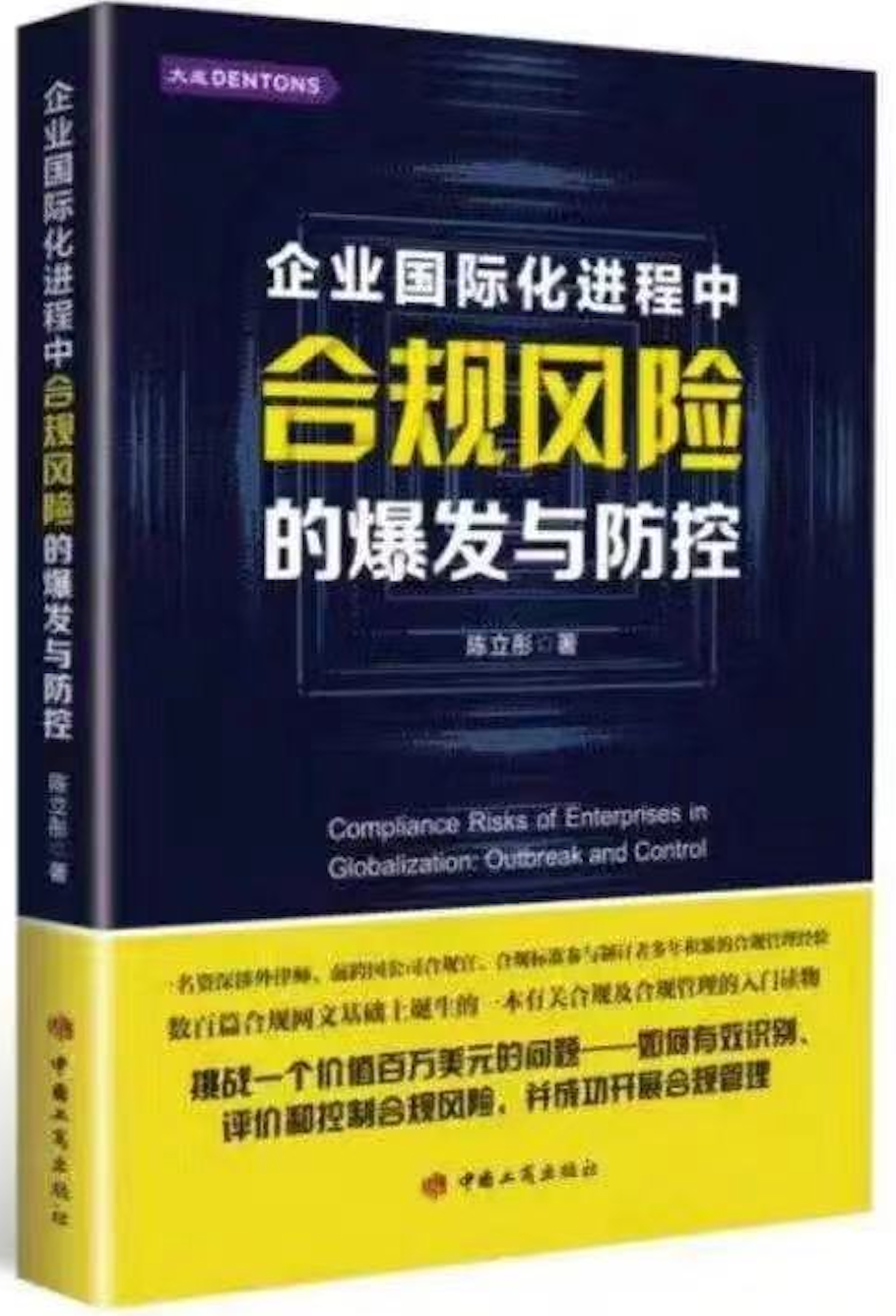
The book I just showed you is "Outbreak and Prevention of Compliance Risks in the Process of Enterprise Internationalization" that I wrote. This book specifically highlights the risks in the process of enterprise internationalization, and talks about many reasons. A large part of the reasons are those I just mentioned, and there will also inevitably be some regulatory bullying. Regulatory bullying refers to the bullying from the regulatory side, where the compliance side is bullied by the regulatory side. This situation does exist.
We have a bank that was launched a criminal investigation for money laundering by local police in Spain. The bank's European executives urgently flew to Spain and went to the police station. He thought that as a European executive of such a large bank, he should be given certain courtesy. But the police said after seeing him: "Arrest him first." This is a typical case of regulatory bullying. Therefore, this puts forward higher requirements for enterprises going global on how to establish a sound compliance management system and how to control compliance risks.
2
Question 2
Moderator - Jiao Shike:
What risks might cross-border enterprises currently face?
Guest - Lawyer Chen Litong:
First, let’s talk about how to classify these risks.
If we use the comprehensive risk management for central SOEs, risks can be divided into: strategic risk, market risk, operational risk, financial risk, and legal risk — this is the classification of risks in the comprehensive risk management guidelines.
From this classification, we can see that the risks faced by enterprises roughly range from legal risk to market, operational, and strategic risk. This is one classification method, and it also intuitively reveals various risks that our enterprises may face when going global.
Another classification method is called compliance risk, and there are also various different classification methods. The compliance risk classification that I personally prefer can be divided into legal risk, employee fraud risk, and operational risk. Legal risk, as the name suggests, refers to risks arising from laws — risks from doing what the law prohibits, or risks from failing to do what the law requires, which is also not acceptable.
Another type is risks caused by improper operation; some things, because we don’t know how to operate, for example, a slip of the finger and pressing an extra zero, this is operational risk.
There is also fraud risk. It may come from internal employees of the company or external third parties. The characteristic of these fraud risks is that companies are often not punished for fraud risks, but fraud risks can bring significant losses to the company.
Regardless of the classification, the risks of enterprises going global are real, and these risks require us to take different measures to prevent and control them.
Common risks for enterprises have risk management tools.
For example, quality control risk is probably the most important risk to control when running a business, it is risk #1. If the quality of the products produced is poor, or even there are cases of fraud, such as Changsheng Pharmaceutical, which produced fake vaccines and even caused deaths. From this perspective, quality risk may be one of the most fundamental and basic risks that enterprises need to focus on solving.
There are many other risks for enterprises. Now, compliance risk has become a very important risk to control. Why is that?
Compliance risk is closely related to the legal and compliance obligations that enterprises must abide in the places they operate. If our enterprises do not understand the legal requirements of relevant countries, or take risks to do business, they may be punished by that country and face so-called extraterritorial jurisdiction. We can certainly express indignation and protest against extraterritorial jurisdiction, but at the same time, we must also manage these compliance risks in a practical way — this is what we call risk identification, risk assessment, and risk control. We need to pay attention to these risks at all times. In fact, when we do compliance work, we are constantly reminding our enterprises to pay attention to the risks they face. For example, many enterprises now go to the European Union and Germany to open factories or become suppliers to the European Union. For instance, Germany recently enacted a law called the Supply Chain Due Diligence Act, which requires German companies to conduct due diligence on their supply chain suppliers. The focus of the investigation is twofold: human rights and environmental protection. If German companies fail to conduct due diligence, they will be punished. Accordingly, these German companies will put forward compliance requirements to their supply chain suppliers; if the suppliers do not meet their compliance requirements, they may cut off the supply chain and no longer be suppliers, which will have a significant impact on business.
Questions from live stream audience
Host - Jiao Shike:
What is the risk of extraterritorial jurisdiction?
Guest - Lawyer Chen Litong:
The book "Outbreak and Prevention of Compliance Risks in the Process of Enterprise Internationalization" provides a very detailed description of extraterritorial jurisdiction. Extraterritorial jurisdiction should start with the extraterritorial effect of laws. In fact, many laws of every country have extraterritorial jurisdiction effect.
For example, China's Criminal Law has extraterritorial jurisdiction effect. If a foreigner infringes on the interests of Chinese enterprises, citizens, or even the state and violates the Criminal Law, "though far away, he will be punished." Chinese laws have this extraterritorial jurisdiction effect, and foreign laws also have extraterritorial jurisdiction effect.
U.S. laws have a very large impact on Chinese enterprises, especially those engaged in international business. For example, the U.S. Foreign Corrupt Practices Act, economic sanctions, and laws related to export control will all affect Chinese companies.
Three
Third Question
Host - Jiao Shike:
The current business environment is becoming increasingly complex. To comply with laws and regulations, what compliance work do enterprises need to do?
Guest - Lawyer Chen Litong:
Compliance management focuses on compliance risks. Our compliance management is to identify these risks. We need to mark those mines with red labels and small red flags, indicating that there are landmines here that we cannot step on. Or when we cross a minefield, we need sappers to clear the mines. Therefore, first we must identify the risks, then manage and control them, and use various methods to control the risks.
Sometimes enterprises face many risks, and it is impossible to deal with them all equally. Some of these risks are high, some are medium, and some are low. We need to evaluate and assign values to the risks, calculate their risk values, and then sort them into high, medium, and low levels. This way, we can accurately allocate the enterprise's limited resources to control various risks. For high risks, we invest more manpower, material resources, and financial resources; for medium and low risks, we invest relatively less. This is how we control risks.
Identifying, evaluating, and controlling risks is not enough. The compliance management we talk about is a systematic project with many necessary conditions. Without one, compliance management may not be done well.
Let me give an example that we often overlook. For instance, training requires records and documentation to prove that employees have participated in the training. Sometimes people think it doesn't matter, right?
There was a company that was investigated by our government authorities for violating anti-monopoly laws. When the company responded to the investigation, it said, "We attach great importance to anti-monopoly laws, and we also attach great importance to this risk. We have conducted a lot of training for employees, but the employee who had the problem did not follow our training requirements and violated the law knowingly, so this matter cannot be blamed on us. We should be given a reduced or exempted penalty." The law enforcement agency said, "Show me the records of the training for that employee." As a result, the company could not find them. Can you still say that you attach importance to this law and compliance risks?
Regarding compliance risk management, there is a standard called the Compliance Management System, ISO 37301.
This standard integrates the best practices of compliance management, including those best practices that must be done to effectively control risks. If you follow this standard, you will be close enough.
Therefore, our compliance management should follow the standard to implement it. ISO 37301 is a Class A international standard that can be implemented. We used to have ISO 9001 quality management system to control quality risks. Now, in the face of these compliance risks, and the possible compliance risks that enterprises may face when being punished at home and abroad, we have the ISO 37301 compliance management system international standard, which many enterprises are implementing. Although there was the pandemic in 2022, relevant certification bodies issued more than 1,000 ISO 37301 certificates in 2022 alone.
We have also helped many enterprises with consulting and standard implementation. For example, Haier Smart Home, Chengyu Expressway, Qingdao Tobacco, and many central SOEs and local SOEs. Recently, we worked with a port group company and its 12 subsidiaries. We provided consulting and assisted them in certification and standard implementation. Therefore, controlling compliance risks through standard implementation is a relatively good method.
In addition, we also need to build a compliance culture. What is the effect that a compliance culture should achieve? The key lies in whether you believe that compliance can bring value. If you believe in compliance, want to build a century-old enterprise, and truly regard compliance as a magic weapon, you must embed compliance deeply into the corporate culture. The effect achieved is not "I have to comply" but "I want to comply", so that compliance management can be done well.
Therefore, from this perspective, compliance is divided into four dimensions. The first dimension is compliance with obligations, including abiding by laws and regulations. Without rules, nothing can be accomplished. If you don't even abide by the law, how can you talk about compliance? The second dimension is compliance management. Doing compliance management alone is not enough. Compliance management has many necessary conditions. Compliance that is not systematic is vulnerable. Therefore, we need to rise to the third dimension: the construction of a compliance management system. This is still not enough. We also need to cultivate corporate culture. It's not just about "I have to comply", but more about "I want to comply", making compliance our habit. With these four dimensions, we can do compliance management well and control compliance risks.
Four
The Fourth Question
Moderator – Jiao Shike:
In the operation and compliance of cross-border companies, what issues are most easily overlooked, and how can these risks be avoided?
Guest – Attorney Chen Litong:
Take listing as an example. Many companies actually fail to make proper plans when going public. They do not identify risks well and lack a holistic awareness of risk management, leading to problems that become too entrenched to fix.
I know many companies, starting from scratch before listing, have no awareness of risk prevention and control. By the time they want to list, it is too late. What do they do? Many companies take huge risks by completely falsifying their listing documents. Does this mean the fraud goes undetected? No! US law enforcement is quite "cunning." They have a law called the Dodd-Frank Act. What does this mean? It means whistleblowers are rewarded. If law enforcement verifies the report and the fine exceeds $1 million, the whistleblower can receive a bonus of 10%-30%.
The SEC states there is no cap on whistleblower rewards.
Overseas listing imposes high standards and strict requirements on our compliance; we cannot let our guard down. Therefore, I believe the hardest part is lacking risk awareness. Many people subscribe to the idea that if you walk by the river often enough, your shoes will inevitably get wet. They handle matters by making a phone call, treating leaders to dinner, or solving problems over heavy drinking, bringing this Chinese approach to risk prevention overseas.
For example, a company gave red envelopes (bribes) to officials in Bangladesh. The recipients handed the red envelopes to the Chinese Embassy, while media followed behind taking photos and videos, which were then published by foreign media.
Companies encounter many problems overseas. Why? Because they mistakenly treat foreign countries like China. When making money, they only think about the profit, without realizing the risks behind the money.
So, I believe the biggest issue is having risk awareness, followed by strategic planning. Some entrepreneurs do not engage in risk strategy planning. After obtaining a green card, they find that the US global taxation system is unbearable and decide to renounce citizenship. Unfortunately, under US law, they must pay an expatriation tax. There are already respected entrepreneurs who paid millions of dollars in expatriation taxes just to "escape" the US. Without planning, things go even worse.
Many companies do not believe in compliance, nor in the power of compliance or moral integrity. But consider those century-old businesses: none achieved success by cutting corners. Cutting corners might result in a good shot, but has any world champion won by relying solely on lucky bounces off the edge?
Some family businesses are now beginning to prioritize risk prevention and control in succession planning, managing risks first to ensure smooth generational transition. It should not be like passing the parcel, where instead of flowers, they are passing grenades or time bombs—some explode in the hands of the first generation before being passed on. Changsheng Bio-Technology is an unfortunate example. The "Vaccine Queen" took 15 years to ascend to her throne, but fell from grace in just 15 days, causing her entire family to collapse.
However, some entrepreneurs are accustomed to the mindset of "if you don't have money, you can't buy medicine; if you have money, you can buy a coffin," which is deeply distressing. This applies not only to going abroad but also domestically. Recently, I encountered a very good enterprise with annual revenue of one or two hundred million RMB. It was lured into listing by others, but its owner lacked risk awareness regarding capital market compliance. Consequently, he was gradually deceived by unscrupulous securities firm managers into buying a bad shell company. Later, his younger brother was arrested and sentenced to three years for refusing to comply with court judgments, and his wife was sentenced to six years for insider trading.
Why did an excellent enterprise generating one or two hundred million RMB end up with a broken home and financial ruin? Lack of risk prevention and control awareness.
I also read a true story where our journalists praised Chinese private entrepreneurs for being savvy in business in Africa. What did they bring to Africa? Boxes of Maotai liquor. They used this example to mock "American imperialist" businessmen. In contrast, what did those arrogant American businessmen bring? They brought even more arrogant lawyers and accountants. This was from a real article I read. With such a mindset and compliance awareness, how can one build a century-old business?
Five
Question 5
Moderator - Jiao Shike:
Facing constantly changing regulations and standards, how can enterprises maintain a keen response and coping capabilities?
Guest - Lawyer Chen Litong:
I used to be the Compliance Director for Asia-Pacific at Ford. Although I am a Chinese lawyer and a lawyer admitted in the State of New York, I don't understand the laws of regions in Asia-Pacific outside of China. How could I perform compliance management and fulfill the responsibilities of the Asia-Pacific Compliance Director?
First, I need to understand management. When we do compliance, we first need to understand management. There are many management tools. I mentioned earlier management science, management standards, management compliance culture, etc. We need to learn all these systematic things.
Second, we must not forget the basic dimensions of compliance management. What are the basic dimensions? It is compliance with laws and regulations. If we don't understand local laws and regulations, and have no awareness of identifying risks, that won't work. We once worked on a compliance management construction project for a state-owned enterprise. The enterprise had already sold products to the UK, with sales reaching 100-200 million yuan, but they were unaware of some important UK regulations and had no understanding of the laws and regulations that could lead to major compliance risks.
I asked them, "Do you know that the UK has a Bribery Act? Do you know that the Bribery Act requires the establishment of an anti-bribery management system?" If an anti-bribery management system is not established, the first violation may be forgiven, but if a second violation occurs, criminal fines may be imposed because the anti-bribery management system was not established, and the company's leaders may bear criminal responsibility.
When does compliance end? Discussing the first UK case of failure to prevent bribery
In addition to understanding management, system construction, and cultural construction, we must also be good at using compliance experts and lawyers from various regions to help identify compliance risks. Many law firms have Newsletters. Have you subscribed to their Newsletters? Besides that, have you empowered local business personnel with some compliance functions? For example, do you have them read local newspapers, monitor the issuance of local laws and regulations, participate in local industry associations, and learn about risk scenarios, laws and regulations, and law enforcement status from them? Do you do these things?
As I mentioned earlier, Germany's newly issued Supply Chain Due Diligence Act will have a significant impact on our supply chain. Two multinational corporations are currently being investigated by German law enforcement authorities and may face fines of millions of euros.

Six
Question 6
Host - Jiao Shike:
Facing constantly changing regulations and standards, how can enterprises maintain keen responsiveness and adaptability?
Guest - Lawyer Chen Litong:
First of all, compliance work can sometimes be very challenging, especially in regions with a poor law enforcement environment.
In the short term, especially in some regions with a poor law enforcement environment, compliance work may sometimes put enterprises at a disadvantage. We often say "the early bird catches the worm, but the compliant bird gets no worm" – this situation does exist sometimes. However, enterprises that aspire to become century-old enterprises must not take chances. A cautious approach ensures long-term safety; the key lies in compliance management.
What value does compliance bring?
First, in the long run, compliance can bring positive energy to enterprises. Being recognized as a compliant and trustworthy enterprise is invaluable and hard to buy. Enterprises that cut corners and engage in fraud can only deceive people for a while, not for long.
Look at the century-old enterprises that have succeeded internationally – none of them were built on fraud. So enterprises that aspire to become century-old ones must believe in the value of compliance. Accordingly, compliance can bring added value in strategy, products, and for family businesses, added value for the family and their assets.
Second, from a tactical perspective, compliance also brings many benefits. As I mentioned earlier, it is a management tool that helps identify an enterprise's weak points. We often say an enterprise is like a wooden barrel: the amount of water it can hold is determined by its shortest plank. No matter how much money an enterprise makes, if there is a short plank, water will leak out at that point. So tactically, compliance work aims to identify those weak points. Some enterprises do not have a problem with short planks, but with the hoops of the barrel breaking, leading to the barrel falling apart, the enterprise collapsing, and the family breaking down. So tactically, compliance can also help identify those weak points, control risks, and add value to the enterprise.
Additionally, as long as an enterprise operates, it will inevitably face risks. People often ask us: "Lawyer Chen, is compliance only necessary for large enterprises, not small ones?" In fact, that is not the case. Some small enterprises deeply abhor certain risks.
Why did Liu Qiangdong swear to spend whatever it takes to root out corrupt employees? Because when he first started his business, he suffered a major fraud case: a cashier girl and a cook at his restaurant ran away with the money. So from that time on, he has deeply hated employee fraud.
From this example, we can see that small enterprises have their own risks. When Liu Qiangdong first opened his restaurant, employee fraud was a huge risk that could have directly put his small restaurant out of business. Of course, now that JD is large, it definitely faces other risks.
Private entrepreneurs also tell us: "Lawyer Chen, when you train us, you say we can't do this or that. We do these things every day, but can you tell us how to prevent our employees from taking bribes?" So large enterprises have their own risks, small enterprises have their own risks – all must do compliance and manage risks well.
Seven
Seventh Question
Host - Jiao Shike:
In your practice, have you encountered consequences caused by clients ignoring compliance issues? How did you make clients aware of these risks?
Guest - Lawyer Chen Litong:
We recently worked on a compliance management system construction project for a company. Initially, the company only wanted to set up a system for the group headquarters. Later, after we provided training and shared examples, they decided to expand the compliance management system to cover 12 subsidiaries. So it's 1 plus 12, meaning the group company and its 12 subsidiaries all need to meet the ISO 37301 standard. I told them the example of the Tianjin Port explosion. There are two approaches to compliance: one is to repair the fold after a sheep is lost, like what happened at Tianjin Port, which was too late, with many casualties, huge losses, and many people being arrested.
If Tianjin Port had implemented compliance earlier, conducted risk penetration and risk investigations, the outcome might have been different. What does risk penetration mean? Tianjin Port not only needed to focus on its own operations but also had to penetrate into its underlying business partners to check if they had risks and whether they were risk sources for Tianjin Port. If the problematic dangerous goods warehouse had been identified earlier, the result would have been different.
Another concept is collective management, where everyone works together to prevent and control risks.
A large state-owned enterprise with annual revenue of over 50 billion yuan approached us and said they wanted to establish a compliance management system, asking for a quote. They told me: I heard you can get a certificate for tens of thousands of yuan, even just 20,000 to 30,000 yuan.
I replied: That's way too expensive. The cost of printing a certificate is probably less than one yuan. If you want a fake compliance and a fake certificate, isn't it too expensive to charge more than one yuan?
When it comes to building a compliance management system, I've only heard of building a compliance management system earnestly to create a golden shield, control those risks, and then mitigate or avoid penalties. But I've never heard of a company facing an investigation, requesting to mitigate or avoid penalties from law enforcement authorities, and then presenting as a reason to the authorities that they didn't spend money on building a compliance management system initially, so they should get a lighter penalty or exemption.
Therefore, I think many enterprises need to balance between value and price, to figure out what is more suitable for their own business, and how much the risk would be worth once it occurs. They need to think this through clearly, so that they can choose a better and more professional team.
Eight
Question 8
Host - Jiao Shike:
At this stage, what are some successful cases of Chinese enterprises integrating into the international compliance trend?
Guest - Lawyer Chen Litong:
There are many successful cases. China International Marine Containers (CIMC) implemented the anti-bribery management system standardization work very early on. When it acquired a problematic enterprise abroad (in Germany), because it had implemented the anti-bribery management system standards, it integrated these problematic enterprises along the way. As a result, after implementing the standards, these problematic enterprises became highly sought-after suppliers.
Nestlé Coffee has done an excellent job in compliance, known as the "number one case in the compliance field." Why? Because they truly used compliance to build a golden shield. Some of their employees sold formula milk powder and bribed some doctors and nurses to get them to prioritize promoting the company's formula milk powder. Others bought information on pregnant and lying-in women from some doctors and nurses, which violated criminal law. These employees were arrested, and their lawyers argued that this was the responsibility of the company. What does "company responsibility" mean? It refers to corporate crime, where the company's leaders would be held accountable. But the judge said: Wait, let's see if Nestlé Coffee has done a lot of compliance management work, with systems, training, contracts, and system construction. Is this still the company's responsibility? No, it is not the company's responsibility, but the individual responsibility of the employees. So the employees should bear the corresponding responsibilities, and this is not the company's responsibility. Compliance inherently has the function of distinguishing between company responsibility and individual responsibility, which is also a good example of compliance.
There are other good examples. A Chinese enterprise went abroad to acquire an enterprise in the United States, which was a military enterprise. It was criticized locally and the acquisition was halted, requiring the enterprise to come over. As a result, the enterprise answered 10 questions all related to compliance, showing that it had done an excellent job in compliance, and gave satisfactory answers one by one. Then the US government gave it the green light to proceed with the acquisition.
There are also some compliance measures that have to be taken, such as ESG compliance, which must be done now. If not, it will not be considered green finance, and carbon emissions may not meet the standards in the future. Perhaps in a few years, products will not be able to be sold to Europe or enter their industrial chain. Therefore, many enterprises that have done well in compliance have started to make arrangements for carbon emissions. Not only do they need to be compliant themselves, but also the entire industrial chain needs to be compliant.
Nine
Question 9
Host - Jiao Shike:
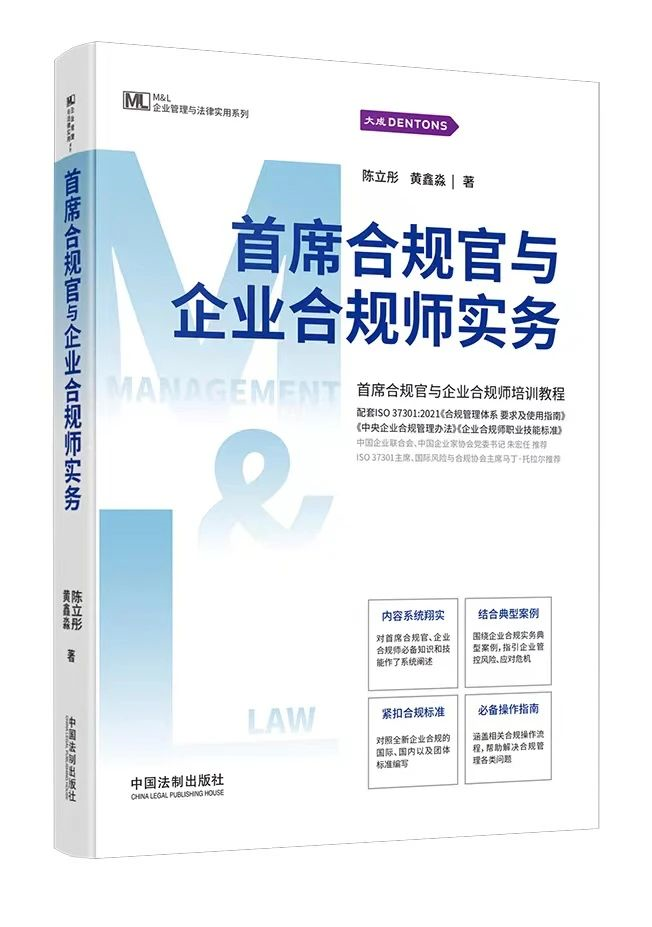
Corporate compliance relies on professional compliance experts and the cooperation of all members of the company. Could you talk about your new book published this year, "Chief Compliance Officer and Corporate Compliance Practitioner Practice"? What are its main contents and what value can it provide for enterprises?
Guest - Lawyer Chen Litong:
"Chief Compliance Officer and Corporate Compliance Practitioner Practice" is written in a relatively professional manner. Its target readers are experts and compliance officers, but it has also become a bestseller ranked first in the legal practice category on Dangdang. Our entrepreneurs and actual controllers can also buy it to read; there are many cases inside.
It covers many topics, such as the construction of a compliance management system, compliance audits, compliance management system reviews, how to conduct investigations in the future and so on, so they complement each other. One cannot just look at the surface; sometimes some professional content still needs to be explained. Therefore, this book is also written in a relatively systematic and comprehensive way, helping enterprises fully understand what compliance officers should do to help the enterprise do its work well.
In the chapter on crisis management in our book, it talks about how to conduct crisis management during product recalls - when facing a product recall, it is not simply about finding someone to intercede, but to argue based on facts, conduct analysis, know both yourself and your opponent, and resolve the problem.
Expert Services
Host - Jiao Shike:
From your professional perspective, what services can be provided for entrepreneurs?
Guest - Lawyer Chen Litong:
First is the risk of employee fraud, including job embezzlement, corruption, employee bribery, and conflicts of interest with shadow companies. These all constitute employee fraud risks. According to statistics, employee fraud risks can cause up to 5%-6% of a company's turnover.
If a company has an annual revenue of 250 billion U.S. dollars, 1% of that is 2 billion U.S. dollars. How many products need to be sold to earn that money back? Because every company has fraud risks. Every company has them, so for a business to survive, calculate how much 1% of the turnover is. If you can recover that money through employee fraud risk prevention and control, that's equivalent to earning it.
Second, if our company wants to go public and become a century-old enterprise, the construction of a compliance management system must also be implemented properly.
A catering company almost had its IPO aborted on the Hong Kong Stock Exchange due to employee bribery. The reason was that during the IPO process on the Hong Kong Stock Exchange, it was exposed that an employee had solicited bribes from suppliers, and the Hong Kong Stock Exchange suspended their listing process. Why? Because the company was not clean, and its corporate culture promotion was not done well. Having such employees shows that the company is not very good either. So don't think these risk preventions are far away. Every enterprise, from small to large, has corresponding risks at each stage that need to be prevented and controlled. For small businesses, preventing and controlling fraud risks is essentially making money.
Exciting Preview for Next Issue
"Haima Super Interview" Episode 13
Live Broadcast Time: Tuesday, May 23, 19:30
Theme: Financial and Tax Compliance Mistakes Entrepreneurs Must Know – Avoiding Pitfalls for a Smooth IPO!
Special Guest of This Episode: Li Ruohan, Certified Public Accountant of China, Director of the Listing Compliance Project at Cloud Innovation Future Guangzhou Listing Counseling Center and Yingzheng Consulting. He has focused on financial and tax management and planning for many years, and has provided financial compliance and tax planning services for many listed companies and large private enterprises in the United States, Hong Kong, China, and mainland China. He has successful case experiences in industries such as real estate, health industry, infrastructure, manufacturing, and cultural development.
Scan the code below to book the live broadcast. See you there!

Originally published on 金盒企业管理集团
