




Blog
A Brief Discussion on the US OTC Market: From Chinese Concept "Meme Stock" Yingxi Group's Transfer from OTC to NASDAQ Listing

Wednesday, August 31, 2022, Eastern Time, Addentax Group Corp. officially transferred from the U.S. OTC market to the NASDAQ, with the stock ticker ATXG. Addentax Group's initial public offering (IPO) on the NASDAQ was priced at $5.00 per share, with a market capitalization of $158 million; on the first day of trading, the stock opened at $27 per share, representing a 440% increase from the offering price. The stock continued to rise during the trading day, closing at $656.54 per share, an increase of 8653.87%, with a total market capitalization of $20.808 billion.
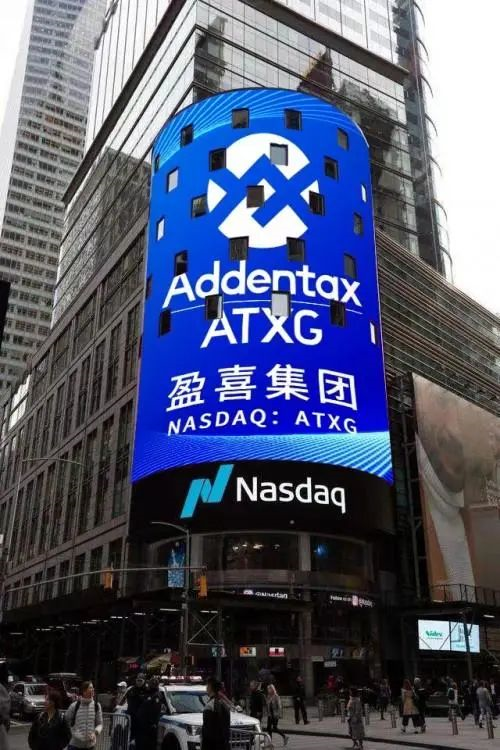
Addentax Group is headquartered in Shenzhen, China. It entered the textile and apparel industry in 2000. After nearly 20 years of development, it has now become a comprehensive group company focused on industrial chain services in the textile and apparel industry, with business operations spanning the globe.
Addentax Group owns 6 domestic operating subsidiaries. Its apparel industry chain model includes modules such as design, R&D, supply chain, production support, terminal sales, and brand centers, and it supplies goods to major domestic apparel wholesalers. In terms of logistics business, Addentax Group has established four service systems: e-commerce distribution, cargo transportation, information tracking, and warehousing management, providing one-stop professional logistics services to customers with the most efficient operational management. Its developed logistics network covers 7 provinces and 2 municipalities directly under the Central Government in China, approximately 79 cities, and plans to develop 20 additional logistics points in existing service cities by 2021.
Financial reports show that Addentax Group's revenue for fiscal year 2021 (ending March 31, 2022) was $12.69 million, while revenue for the previous fiscal year was $24.7348 million, a significant year-on-year decrease of 48.7%.
Origin of the U.S. OTC Market
However, Addentax Group had almost no trading activity on the OTC market, which is a major weakness for Chinese concept stocks. Nevertheless, an increasing number of Chinese concept stocks are using the OTC market to achieve a successful transition. The U.S. OTC (Over The Counter) market is the world's oldest securities trading venue. It originated from banks engaging in stock trading business, and because stocks were sold to customers at bank counters, it was called the over-the-counter market. Since this type of trading does not take place on formal exchanges, it is also referred to as the off-exchange market or the counter market.
The OTC market is completely different from the exchange market. The OTC market has no fixed location, no prescribed membership qualifications, no strictly controllable rules and regulations, no prescribed trading products or restrictions, and mainly consists of one-on-one transactions negotiated privately between trading counterparties. Off-exchange trading is mainly found in the financial industry, especially in countries where financial institutions such as banks are highly developed.
After years of development, the OTC market has gathered many high-quality enterprises, especially in the OTCQX and OTCQB tiers. Compared with listing on the New York Stock Exchange and NASDAQ, the preparation time, cost, and listing standards for enterprises choosing to list on the OTC market are relatively lower, making it suitable for enterprises in the early stages of development or small and medium-sized enterprises. In practice, enterprises can not only directly establish a new joint-stock company in the U.S., operate it for a certain period, and then submit Form S1 to the SEC to apply for listing on the OTC market; they can also choose to conduct a reverse takeover (RTO) with a company already listed on the OTC market, especially a company listed on the higher-tier OTCQX or OTCQB, thereby achieving listing on the OTC market.
Many quality Chinese concept stocks have traded on the OTC market, including Bank of China (Code: BACHF), China Construction Bank (Code: CICHY), Agricultural Bank of China (Code: ACGBY), Industrial and Commercial Bank of China (Code: IDCBF), Bank of Communications (Code: BCMXY), etc. There are also some private enterprises, such as Sinovac Biotech, Yangling Botaisen, Dalian Fu's, Shanxi Puda, Far East Energy, Qingkelong Supermarket, Shenzhen Ketong, BAK Battery, etc., which were listed on the US OTC market before successfully transferring to the US main board market. Currently, the US OTC market is the world's largest over-the-counter market, with advantages such as large scale, high liquidity, simple listing procedures, and connection with NASDAQ and NYSE.
The OTC market in recent years has shown several major trends:
Trend 1: The amount of financing is getting larger and larger.
Chinese enterprises financing in the OTC market are raising increasingly larger amounts. Ten years ago, the US OTC market was a place for small enterprises to go public, raising small amounts of money, millions of US dollars, or 10-20 million US dollars, but in recent years, it is often 40-50 million US dollars. It should be noted that above 50 million US dollars is considered large-scale financing in the US, while 5 million or 10 million US dollars is small-scale financing. In the past, the OTC market was a small market with small funds, but in recent years, the amount of financing has been growing larger.
Trend 2: An increasing number of enterprises transfer to the main board.
According to relevant US laws, if listed enterprises on the OTC market meet the listing standards of NASDAQ or NYSE, they can apply to the main board exchanges to be listed and traded on NYSE or NASDAQ. In recent years, more and more companies have transferred from the OTC market to the main board market. A few years ago, there were only a few scattered cases, but in recent years, it has formed a batch, and the OTC market has gradually been recognized as a stepping stone for many enterprises to enter NASDAQ and NYSE; in the past few years, about 25% of new listed companies on the main board each year have transferred from the US OTC market.
Trend 3: The quality of listed enterprises has improved.
The quality of Chinese enterprises listed on the US OTC market is getting better and better. In the past, only enterprises that couldn't go anywhere else went to the OTC market, but now very good enterprises also go public through the OTC market and transfer to the main board market.
Originally published on 金盒企业管理集团
