

华腾地毯
Sky Supreme
- 0
- Products
- 0
- Followers
- 2004
- Established
FAQ
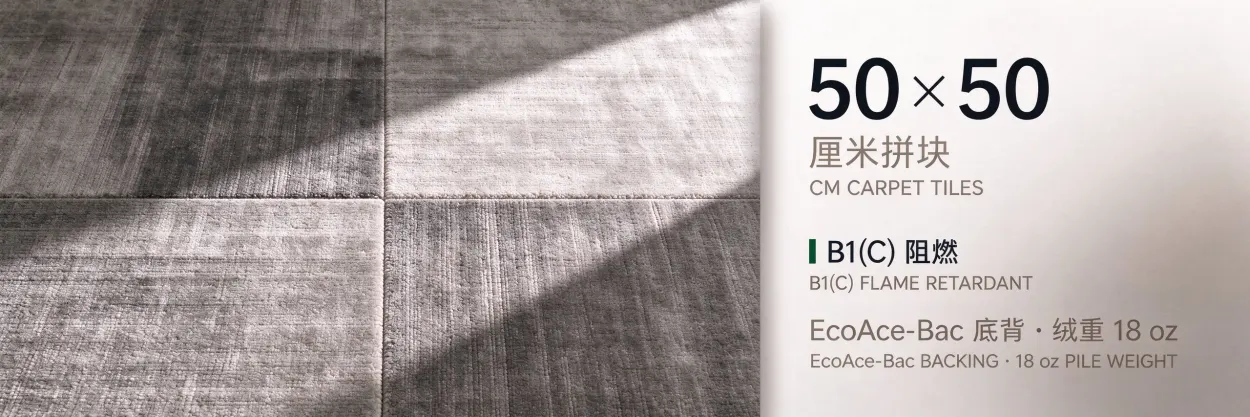
QHow many pieces of 50×50 carpet tiles are needed per square meter?
First, the numbers: 1 square meter equals 4 pieces. One 50×50 cm tile is 0.25 square meters, so 100 square meters is 400 pieces.
When actually ordering, you cannot just multiply by this number. Cutting is required along walls, column bases, and doorways; a 2×2 m pattern repeat must also be laid in the same direction, and remaining offcuts cannot be rotated 90 degrees for reuse. Office projects generally add 5%–10%.
Taking 1200 square meters as an example: theoretically 4800 pieces; at 8% it is 5184 pieces, rounded up to 5190 pieces. Baseboards, doorway transition strips, stairs, carpet adhesive, and accessories are not included in this count and must be listed separately.
QCan old carpet tiles be recycled?
Whether it can enter the recycling line depends on the material composition of the pile surface and backing; not all carpet tiles can be recycled.
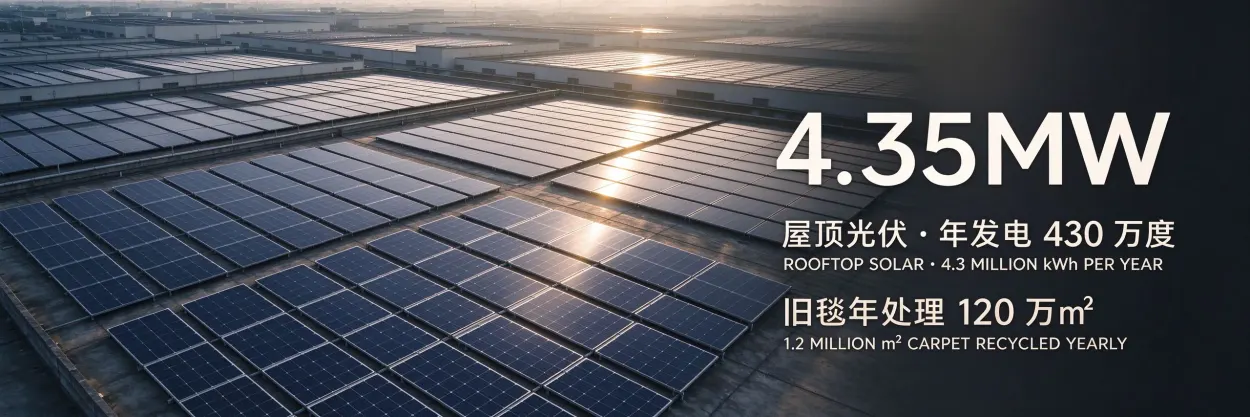
The three Full Circle production lines we planned will process 1.2 million square meters of used carpets and 360 tons of scraps per year at full capacity. Two things need to be confirmed during implementation: material composition (certified nylon, regenerated nylon, or polypropylene; PVC or non-PVC backing) and whether there are local receiving parties.
Generally speaking, chlorine-free non-PVC backings face fewer restrictions in the recycling pathway; processing channels for chlorine-containing backings are narrow, which is also why it is often singled out in environmental assessments.
QOffice Renovation: How to Choose Between Carpet Tiles and Broadloom Carpet?
Decide based on three factors: replacement cost, visual requirements, and lead time & wastage.
In terms of replacement, carpet tiles can be replaced piece by piece when damaged, without having to redo the entire area; localized damage to broadloom carpet often requires replacing a whole roll. Visually, broadloom is seamless, while carpet tiles inevitably have seams; using pattern repeats and laying them in the same direction can make them less noticeable, but cannot eliminate them entirely. Regarding wastage, broadloom is cut by the meter and has low wastage, while carpet tiles generally require an additional 5%–10% allowance due to directional wastage.
Scenarios favoring carpet tiles: multi-room office areas, places requiring localized updates, and multi-story buildings with average handling/transportation conditions. Scenarios favoring broadloom carpet: large open-plan spaces, areas requiring a seamless look, and full-width continuous patterns.
QHow to pass fire inspection for office carpet?
Look at two primary metrics: flammability performance rating and smoke density. We achieve Grade B1(C) according to GB 8624-2012, and Class I according to ASTM E648; smoke density tested within 450 according to ASTM E662.
Three items must match during submission: the model number on the test report must match the tendered model, the issuing organization must be accredited, and the report must be within its validity period. Mismatched model numbers are the most common reason for rejection, not insufficient ratings.
Anti-static performance is a different set of metrics, tested within 3.5kV according to AATCC-134, which is only specifically required for scenarios like server rooms and data centers; it cannot replace the flame-retardant report.
QIs a pile weight of 18 oz considered thick or thin?
It is considered medium-to-heavy. 18 oz/yd² is approximately equal to 610 g/m²: 1 oz is 28.3495 grams, 1 yd² is 0.836127 square meters; dividing the two gives 33.906, which is then multiplied by 18.
However, thickness cannot be judged by weight alone. For the same 18 oz, when the pile height is 3.5 mm, the pile density is about 174 g/L; when the pile height is increased to 5 mm, the density drops to 122 g/L, making it feel softer underfoot and also easier to trap dirt.
Therefore, the correct way to compare is to have the supplier provide both the pile weight and the pile height (with tolerances), and evaluate both numbers together. A quote that only specifies pile weight without pile height is effectively missing half the information.
