




Blog
小金科普 | Why do enterprises set up a VIE structure, and what benefits does a VIE structure bring to enterprises?
Chinese companies have two paths for overseas listing: the H-share model (direct listing) and the VIE model (indirect listing). Since Sina pioneered the VIE structure for its US listing in 2000, the VIE structure has become the first choice for most companies listing in the US.
More and more Chinese companies have established VIE structures to achieve overseas listings, such as internet companies: Alibaba, Tencent, NetEase, Baidu, JD.com, etc.; media and publishing companies: Bona Film Group, etc.; education and training companies: New Oriental, etc. In recent years, VIE structures have emerged in the food, biopharmaceutical, financial services, and even construction and energy sectors.
According to statistics, among the 485 Chinese concept stocks currently listed on the US stock market, at least 3 out of every 4 companies have established VIE structures. The total market value of Chinese companies listed in the US using VIE structures has exceeded one trillion US dollars.
First, overseas exchanges such as the New York Stock Exchange and the Hong Kong Stock Exchange do not accept companies registered in China; second, even if overseas exchanges accept companies registered in China, Chinese companies must obtain approval from China's securities regulatory authorities to list overseas. In reality, except for H-shares, the probability of obtaining approval from Chinese regulatory authorities for overseas listings was very low before. To circumvent this restriction, it is necessary for the listing entity to register a company overseas, usually choosing places like the Cayman Islands, mainly because these places are tax havens and have sound legal systems.
2. Mainland China has restrictions on foreign investment in some industries of internet communications
Domestic policies prohibit or restrict foreign investors from entering the market in certain fields, and the VIE structure can circumvent these two obstacles, enabling enterprises to achieve the purpose of listing.
VIE can successfully circumvent the current foreign exchange control system that is not freely convertible. By establishing companies in the Cayman Islands/BVI, one can enjoy huge tax exemptions and low-cost share transfers, and can also apply for listing in Hong Kong and other countries and regions;
2. Circumvent fields that restrict foreign investment
Chinese laws prohibit or restrict foreign investment in some fields, such as internet information services, tourism, online publishing, education, entertainment, etc.
3. Effectively circumvent government regulation and disputes
By establishing shell companies overseas and using the assets of domestic enterprises for reverse packaging, the overall assets are finally packaged for overseas listing, which not only effectively avoids the supervision of domestic regulatory authorities on foreign investment, but also enables domestic enterprises to successfully raise funds in the US capital market.
4. Simplify listing procedures
Avoids the cumbersome and lengthy approval procedures for domestic enterprises to list overseas; even if it goes through great hardships to pass the approvals of multiple departments such as the Ministry of Commerce and the State Administration of Foreign Exchange, and successfully lists overseas, if business expansion requires issuing additional shares or bonds, further approvals are required.
5. Facilitate financing
Mainland China has foreign exchange control policies, and if there is an overseas structure, it is easier to obtain overseas capital.
6. Wealth maximization
After listing, there are no restrictions on circulation, making it easy to sell stocks for cash.
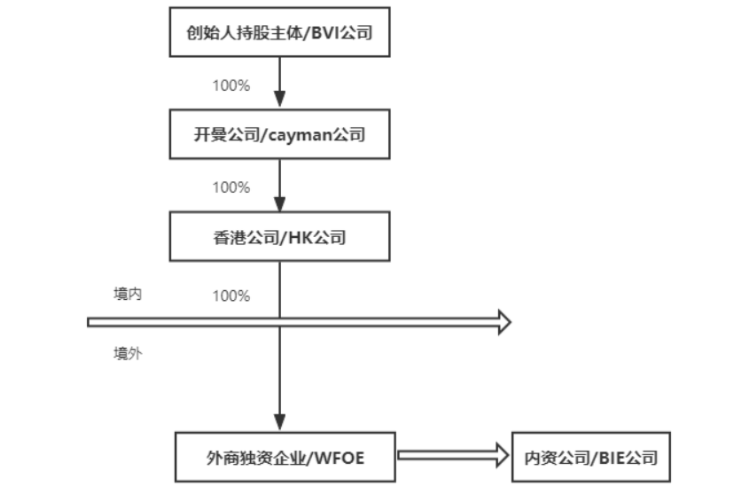
The first layer is the founder's shareholding entity, which often chooses to establish a business company in the British Virgin Islands (BVI) for cost and convenience reasons.
2. The second layer of the VIE structure: establish a Cayman Islands company
The second layer is the future financing entity, which is usually incorporated in the Cayman Islands.
3. VIE Third Layer Structure: Incorporate a Hong Kong company
The third layer is to incorporate a Hong Kong company. On the one hand, this takes into account the tax preferences between the Mainland and Hong Kong when certain conditions are met; on the other hand, when establishing a wholly foreign-owned enterprise (WFOE) in the Mainland in the future, notarization and authentication of overseas shareholders are required. For Hong Kong companies, obtaining such documents is already quite mature, and in practice it is faster and more convenient, and is also highly recognized by the Mainland authorities.
4. VIE Fourth Layer Structure: Incorporate a Mainland Wholly Foreign-Owned Enterprise (WFOE)
The fourth layer, to establish a direct connection between overseas and domestic entities, requires the establishment of a wholly foreign-owned enterprise (i.e., WFOE), which is 100% owned by the Hong Kong company. The WFOE is the first stop for the transfer of overseas financing funds to the Mainland. In the entire VIE structure, the Cayman company holds 100% of the Hong Kong company through direct shareholding, the Hong Kong company holds 100% of the WFOE through direct shareholding, and the WFOE controls the VIE company through a package of control agreements, achieving consolidated financial statements for the VIE company.
The VIE structure realizes the separation of the company's "management rights" and "income rights": the overseas entity obtains income and assets, while the domestic entity is responsible for operation and management. Through the VIE agreements, enterprises can kill two birds with one stone, meeting both domestic regulatory requirements and overseas listing requirements, thus satisfying dual standards.
Originally published on 金盒企业管理集团
