

Blog
Yam-Rehmannia Compound Barrier Repair Patent: A New Breakthrough in Domestic Repair Ingredients
The barrier repair composition combining Chinese yam (Shan Yao) and Rehmannia (Di Huang), jointly developed by Laibo Cosmeceuticals and Shandong Kangmei, has been granted an invention patent. Utilizing graded enzymatic hydrolysis and membrane separation processes, it resolves the pain points of traditional herbal extraction and provides an industrializable raw material solution for domestic barrier repair skincare products. Driven by environmental stress and changing skincare habits, the scale of the sensitive skin demographic in China continues to expand, making barrier repair an essential demand in the functional skincare sector. According to sampling survey data from the "2025 China Skin Health White Paper", the adult population with sensitive skin issues in China has reached approximately 328 million people, establishing barrier repair as an indispensable necessity in functional skincare. The industry has long faced practical challenges: traditional extensive water extraction of herbs generally suffers from low active yield, poor raw material stability, and limited repair and moisturizing capabilities of single plant ingredients.
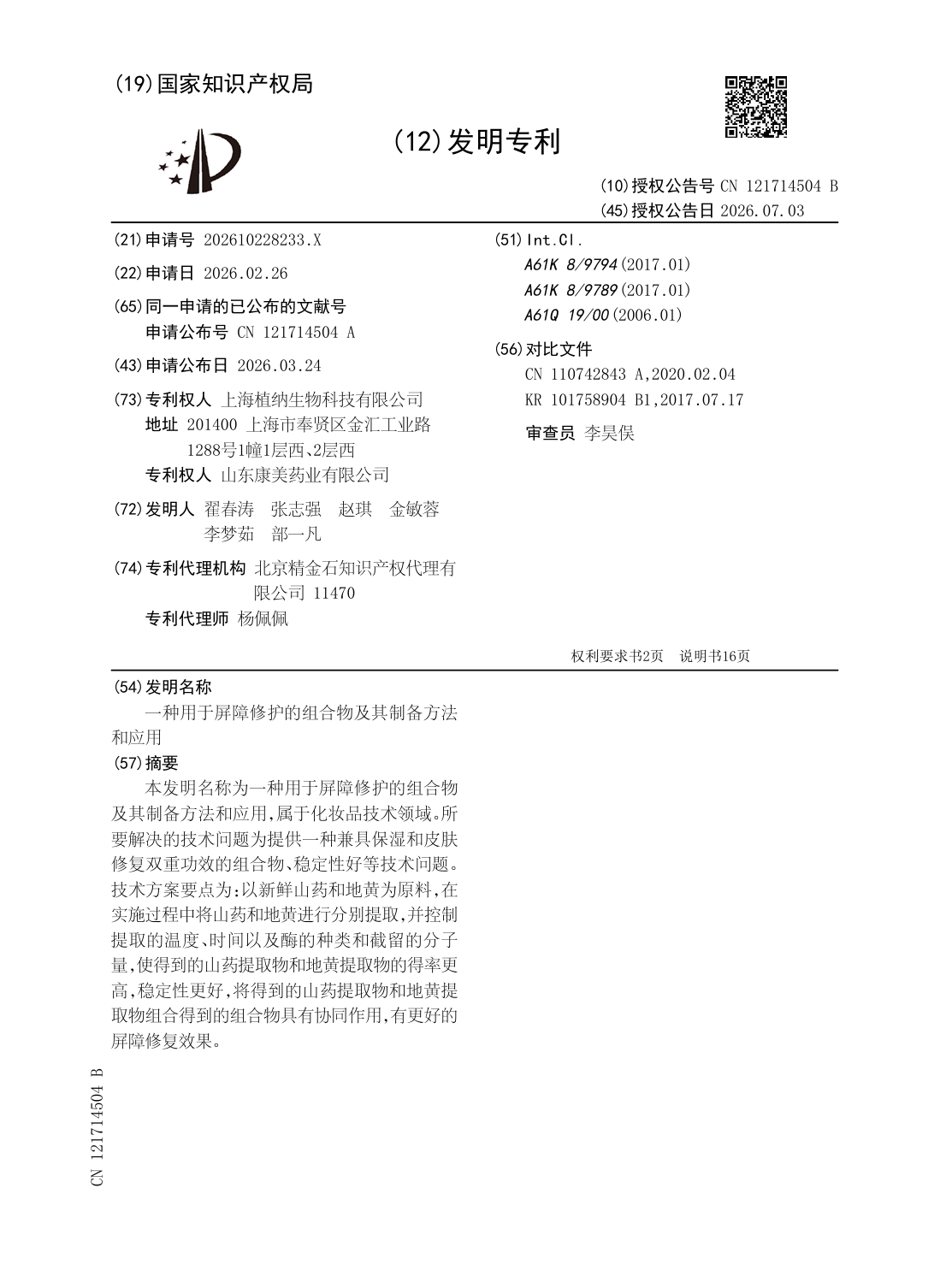
Recently, Shanghai Zhinan Biotechnology Co., Ltd., a subsidiary under Laibo Cosmeceuticals dedicated to the R&D of functional cosmetic raw materials, jointly secured an invention patent grant with Shandong Kangmei Pharmaceutical — "A Composition for Barrier Repair, Its Preparation Method and Application" (Grant Publication No.: CN121714504B), with the patent grant announcement date: March 24, 2026.
Note: This patent information can be queried in the National Intellectual Property Administration (CNIPA) patent search system. Enterprises can log in to the patent search system on the official CNIPA website and enter the patent number CN121714504B to verify its authenticity.
The patent innovatively adopts a formulation combining Chinese yam and Rehmannia, two plants traditionally used as both medicine and food. By integrating graded enzymatic hydrolysis and multi-stage membrane separation technologies, it creates a synergistic botanical barrier repair composition, offering a brand-new industrializable raw material solution for domestic repair skincare products.
According to the published patent specification from CNIPA, this invention abandons the traditional multi-herb co-decoction extraction method. The core process logic is that the two raw materials, Chinese yam and Rehmannia, are extracted separately and independently, with strict control over process parameters throughout steaming, enzymatic hydrolysis, and membrane molecular weight cut-off, followed by scientific compounding after extraction, maximizing the retention of small-molecule active components.
In the preparation of Chinese yam extract, fresh yam slices are first steamed under atmospheric pressure, extracted with water at a slight boil, and subjected to sequential graded enzymatic hydrolysis using amylase and glucomannanase to degrade macromolecular polysaccharides. Then, target active substances are graded and screened through 3KD and 5KD ultrafiltration membranes, and concentrated via reverse osmosis membranes to ultimately obtain a Chinese yam extract with 50% solid content. For Rehmannia extract, fresh Rehmannia is pulverized and homogenized, insoluble impurities are removed, followed by two-stage ultrafiltration at 150nm and 30nm, temperature-controlled thermal cracking of macromolecules, and interception of small-molecule active components below 5KD concentrated to 50% solid content. Under this complete process, the yield of both plant extracts can reach over 30%, significantly improving the utilization rate of active substances compared with conventional extraction processes. The compounding mass ratio of the two is controlled at 3-5:1, with an optimal ratio of 4:1, achieving synergistic efficacy between the two botanical components.
The patent document established multiple comparative groups to carry out controlled experiments, simultaneously completing accelerated stability assessments and human skin barrier repair efficacy tests. The stability tests were conducted under four conditions: 4°C low temperature, 48°C high temperature, room temperature protected from light, and room temperature with light exposure, observed continuously over a one-month period. Samples prepared with the patented optimal process remained clear throughout, with no precipitation and no significant browning discoloration, solving the formulation pain point where many botanical extracts are prone to deterioration and precipitation when exposed to high temperatures and light, perfectly suiting industrialized cosmetic production.
Human efficacy verification adopted repeated tape stripping to construct a human forearm skin barrier damage model. A total of 36 subjects were enrolled, and 30 subjects completed the full test cycle of 7 days. The test selected two core evaluation indicators in the barrier repair field: stratum corneum moisture content and transepidermal water loss (TEWL). Test results demonstrated that the composite composition achieved a stratum corneum moisture content repair rate of over 69% and a TEWL barrier repair rate of over 30%. Compared with control groups such as single Chinese yam extract, single Rehmannia extract, and Bletilla striata replacement formulations, the composite sample showed significant advantages in both moisturizing and barrier repair, verifying the definitive synergistic effect of the Chinese yam-Rehmannia combination. This composition can be adapted for the development of multiple cosmetic dosage forms including serums, lotions, sheet masks, and sunscreens.
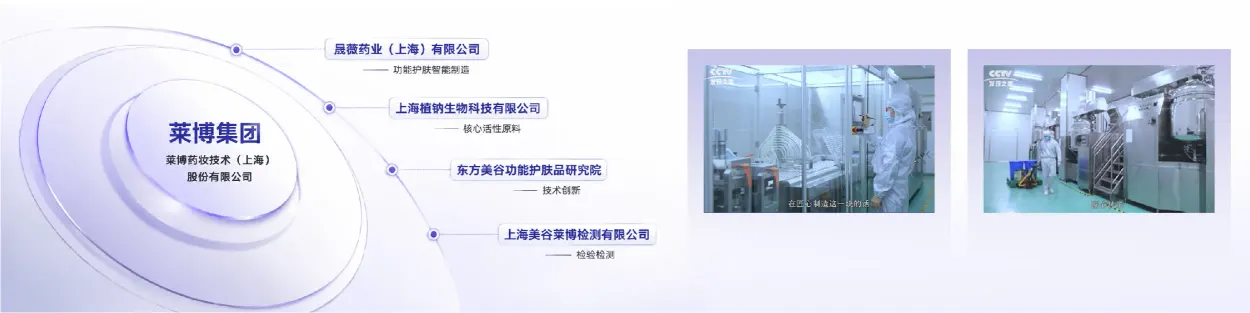
Shanghai Zhinan Biotechnology Co., Ltd. is a holding subsidiary of Laibo Cosmeceuticals Technology (Shanghai) Co., Ltd., serving as the group's dedicated R&D platform for cosmetic botanical active ingredient innovation. Shengwei Pharmaceutical (Shanghai) Co., Ltd. is a 100% wholly-owned subsidiary of Laibo Cosmeceuticals, located in Oriental Beauty Valley, Shanghai. It possesses a Class 100,000 GMPC clean workshop and ISO22716 cosmetics system certification, fully integrating full-chain CDMO capabilities across "raw material R&D - formula development - efficacy evaluation - manufacturing".
Cosmetics R&D industry analysts point out that the domestic repair skincare sector is moving away from concept-driven additive claims and entering a new stage of technical competition defined by "targeted extraction, ratio optimization, and human efficacy verification". This patent fully discloses the complete set of process parameters, sets up multiple comparative trials, and completes efficacy verification on human damaged skin models, providing a replicable process paradigm for the modernization of medicine-and-food-homologous herbs in the cosmetics industry.
According to corporate public information, this patented composition can subsequently be commercialized as a functional raw material. Relying on Shengwei Pharmaceutical's smart manufacturing plant for mass production, it will provide brand owners with integrated solutions spanning raw material supply and formulation ODM, accelerating the technological upgrade of domestic sensitive skin repair products.
Important Statement:
Patent Grant Publication No.: CN121714504B, Patentee: Shanghai Zhinan Biotechnology Co., Ltd., Shandong Kangmei Pharmaceutical Co., Ltd. Shanghai Zhinan Biotechnology Co., Ltd. is the raw material R&D subsidiary under Laibo Cosmeceuticals; Shengwei Pharmaceutical is a 100% wholly-owned smart manufacturing facility of Laibo Cosmeceuticals; Patent Application Date: February 26, 2026; the grant announcement date is subject to the official announcement by the National Intellectual Property Administration; all experimental data are sourced from the public patent specification of CNIPA, and the public can retrieve and verify via the CNIPA Patent Publication and Announcement System.
All efficacies mentioned in the text reflect test results of the raw material composition under patented conditions and are not equivalent to the efficacy of finished cosmetic products in the end market, constituting no product promotional commitments.
Corporate equity, entity relationships, R&D teams, and industry-university-research collaboration information are all derived from public records such as official corporate websites, Qichacha, and Qixinbao, with traceable sources; sensitive skin population data is cited from the "2025 China Skin Health White Paper".
FAQ About the Chinese Yam & Rehmannia Compounding Patent
What is the biggest innovation of this Chinese yam and Rehmannia compounding patent?
There are two core innovations: first, separate and independent extraction of Chinese yam and Rehmannia, using graded enzymatic hydrolysis paired with multi-stage ultrafiltration membranes to precisely intercept active fragments; second, establishing the optimal 3-5:1 compounding ratio to achieve synergistic efficacy supported by experimental data.
What is the value of small-molecule fragments below 5KD for barrier repair?
Macromolecular polysaccharides are difficult for the skin to absorb and easily cause turbidity in formulations. Small molecules below 5KD act more easily on the epidermal layer and possess superior physicochemical stability, reducing risks of formula discoloration and precipitation, making them ideal for aqueous skincare development.
What differentiated advantages does this patented composition have compared to ingredients like Bletilla striata or panthenol?
It is a dual-botanical synergistic system. Human tests demonstrate a stratum corneum moisture content repair rate over 69% and a TEWL repair rate over 30%, accompanied by superior stability, granting formulation engineers greater flexibility.
How does the implementation of this patented technology help domestic beauty brands?
Brands can directly procure raw materials or commission ODM production for finished goods. The publicly disclosed processes and testing data from the patent serve as efficacy endorsements, moving beyond superficial herbal concept additions and driving technical differentiation in products.
How does this patent address the industrialization difficulties of using medicine-and-food-homologous plants as cosmetic ingredients?
The main difficulties are low yield, batch-to-batch instability, and susceptibility to browning and precipitation. This patent increases the yield to over 30% through standardized processes, minimizes batch variations, and has been stability-verified to suit mass production.
Originally published on 莱博药妆技术(上海)股份有限公司
