




Blog
From Kuala Lumpur to Penang: Defu's journey to listing is always accompanied by Golden Box


Conclusion: On October 24, 2026, Daifu Group (Charm International) held the "Charm Fortune Global · Dual Beauty Clinic Director Signing & Dividend Shareholder Recruitment Conference" in Penang, Malaysia. At the conference, the signing of the initiator of the Penang Dual Beauty Clinic Director was completed, and Lily, a director of Jinhe Group, gave a presentation on the U.S. listing strategic plan. The highlight of this event is not the scene, but that it brings together three real issues of medical beauty chain capitalization: why go public, where the real threshold lies, and what a listing course can and cannot say. There is a boundary to be clarified first: the director signing is a business cooperation, and the shareholder recruitment is a commercial cooperation, neither of which constitutes a securities offering; the "U.S. listing" is currently a plan, not an effective arrangement. Information as of November 2026.

I. What This Conference Accomplished
According to the information released by the event organizer, the theme of the conference is "Charm Fortune Global", and two main lines run through the whole day: the signing of dual beauty clinic directors and the recruitment of dividend shareholders. The agenda includes in sequence: the founder sharing the group's strategy and plan, the signing of the initiator of the Penang Charm Wrinkle Dual Beauty Clinic Director, group photo, listing strategic planning course, introduction of product system and market approach, guest sharing, investment promotion plan release, as well as model runway show and interaction sessions.
Jinhe Group participated as a "long-term capital strategy service provider". According to the chronicle on Jinhe's official website, the two sides signed a long-term industrial capital service cooperation at the Kuala Lumpur conference in June 2026, with services focusing on three areas: top-level structure and governance standardization, business model and value system, and global brand value; another Defill listing strategy conference was held in September. From Kuala Lumpur to Penang, it is a continuation of the same capitalization promotion rhythm. (Data source: Chronicle of Jinhe Group's official website, June 30, 2026)
It should be noted that no third-party media reports on the Penang conference itself were retrieved in this article, and the details are sorted based on the public information and conference materials of the event organizer; on-site descriptions such as the number of participants and the number of contracts will not be quantitatively cited in this article.
The basic situation of Defill can be seen from its official website: the group has 5 core enterprises under its umbrella, including the Defill brand, Meizou Biotechnology, Malaysia Charm International, and Malaysia Meizou Business School. The brand matrix is divided into four lines: medical beauty (Defill, Meizou, Yiqimei), scientific beauty (Jitaimai, Jikemai), light health (Yuan Shui Xiangxin), and aesthetic beauty (Defill, Aichen); the official website states that its business has covered tens of thousands of stores in China, and its overseas business extends to Malaysia, Singapore, Indonesia, and Brunei, and it is implementing the "Hundred Clinics, Thousand Stores" plan to land three types of stores: community small stores, tech beauty centers, and dual beauty assistance stores. (The above data is self-stated by the company's official website, and this article has not conducted independent verification)
II. Why are all medical beauty chains talking about capitalization
First, let's look at the industry landscape. According to the "2025 Medical Beauty Industry White Paper", since 2020, China's medical beauty market has expanded at an average annual growth rate of 17.4%, and the market size is expected to reach nearly 370 billion yuan in 2025. (Data source: 21st Century Business Herald quoting the white paper, September 2026)
Structural changes are more noteworthy: non-surgical light medical beauty has become the mainstream of consumption, accounting for more than 53% of China's medical beauty market in 2025, with a scale of about 227.9 billion to 258 billion yuan. (Data source: Sina Finance, February 27, 2026)
The rise in the proportion of light medical beauty has directly changed the cost structure of chain enterprises: single-store investment has decreased, replication speed has accelerated, but the requirements for standardization, supply chain and doctor resources have also increased simultaneously. The more stores there are, the more a unified set of accounts, unified SOP, and unified brand standards are needed — these three things happen to be the first three pages that the capital market looks at when evaluating a chain enterprise.
Capitalization here is a tool, not an end. It addresses three things: capital expenditure for opening new stores, long-term alignment between clinic directors and doctors, and continuous investment in compliance costs. Only when these three points are clearly explained can we talk about the "listing path"; if they are not clear, no matter how well-designed the path is, it is just on paper.
We need to pay attention to common discrepancies in industry data. Some companies claim that "the domestic light medical beauty market has a compound annual growth rate of over 25%", which differs from the 17.4% figure in the white paper; when communicating externally, using third-party data is more reliable and easier to be accepted by auditors.

III. Four Paths and Their Real Thresholds
Medical beauty chains have more than one path to the public market, and the thresholds vary greatly, as shown in Figure 1.
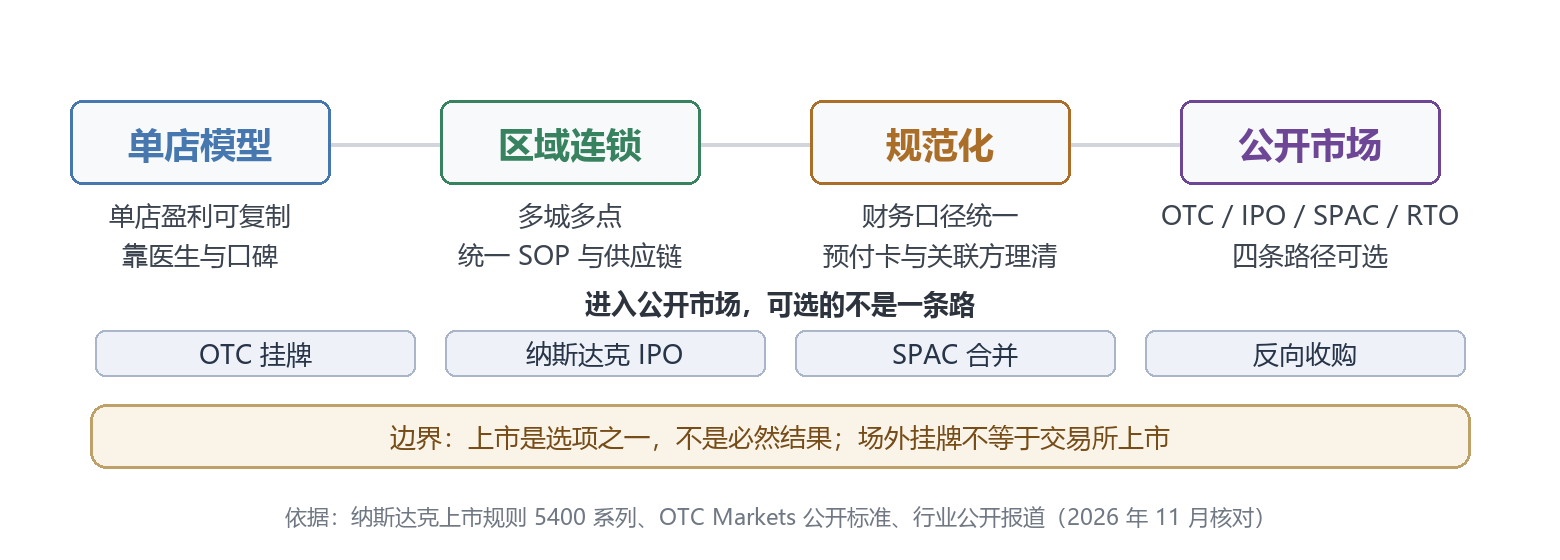
Figure 1 Four Steps and Four Paths for Capitalization of Medical Beauty Chains
OTC listing is the tier with the lowest threshold. According to OTC Markets' own definition, OTCQB and OTCQX belong to the OTC market tiers, which are not the same concept as listing on Nasdaq or the New York Stock Exchange: listing can obtain a tradable code and a certain information disclosure framework, but its liquidity, institutional coverage and financing capabilities are all weaker than those of exchange listings, and a transfer to an exchange still requires meeting all the exchange's standards again. (Data source: OTC Markets public standard document)
The thresholds for exchange IPOs are written in the rules, not in the promotions. Nasdaq is divided into three tiers: Capital Market, Global Market, and Global Select Market, each with multiple optional standards; even the lowest Capital Market tier requires shareholders' equity in the millions of dollars, public market capitalization in the tens of millions of dollars, and also meets liquidity, market maker and governance requirements. (Data source: Nasdaq Listing Center Initial Listing Guide, Nasdaq Listing Rules 5400 series, subject to the latest official version)



SPAC merger and reverse merger are two other paths, each with different risk structures. The former depends on whether the merger can be completed within the agreed time and pass registration and shareholder voting, with the possibility of redemption and termination of trading; the latter depends on whether the historical burdens and audit cleanup of the shell company are clean, and any defects will enter the public market together with the new entity.
A comparison of the four paths can be seen in Table 1 .
Table 1 Thresholds and Key Risks of the Four Paths
| |||||||
|
Path
|
|
Key Thresholds
|
|
Timeframe
|
|
Key Risks
|
| |||||||
OTC Listing (OTCQB/OTCQX) | Meet the disclosure and quotation requirements of this tier; no exchange listing approval required | Usually several months | Low liquidity; OTC listing is not equivalent to a formal exchange listing; moving to an exchange still requires meeting all exchange standards |
| |||
| |||||||
Nasdaq IPO | Tiered review; even the lowest tier requires shareholder equity in the millions of dollars and public float in the tens of millions of dollars | Usually over one year | High audit and governance costs; issuance window and valuation volatility |
| |||
| |||||||
SPAC Merger | Find a suitable target and complete the merger, registration, and shareholder vote | Depends on transaction progress | Uncertain redemption and voting outcomes; transaction may be terminated |
| |||
| |||||||
Reverse Takeover (RTO) | Secure a shell company and complete audits and compliance cleanup | Depends on shell company and cleanup progress | Legacy issues of the shell company, audit and disclosure flaws will carry over to the new entity |
|
This table is trying to convey: among the four paths, there is no "better" one, only "one more suitable for the current financial and governance status". Treating a path as a result to promote is where such activities are most likely to cross the line.

IV. Four Major Hurdles for Medical Aesthetic Enterprises
More difficult than path selection are four things that must be completed before going public. These four matters are particularly challenging in the medical aesthetic industry because they involve two regulatory standards: finance and medical care.
The first hurdle: Prepaid cards and advance receipts. Stored-value cards and treatment packages are common sales methods for medical aesthetic institutions, but according to Article 25 of the "Measures for the Administration of Single-Use Commercial Prepaid Cards (Trial)", card-issuing enterprises whose main business is in the residential service industry shall not have an advance receipt balance exceeding their main business revenue from the previous accounting year; medical aesthetic services fall within the scope of the residential service industry. Large-scale sales of stored-value cards form contract liabilities in accounting, and there are also upper limits for compliance. The combination of the two will directly reduce the "attractiveness" of the financial statements. (Data source: Ministry of Commerce's "Measures for the Administration of Single-Use Commercial Prepaid Cards (Trial)")
The second hurdle: Qualifications and personnel. Medical aesthetic institutions must legally obtain the "Medical Institution Practicing License", with the approved diagnosis and treatment items clearly including the medical cosmetology department and related secondary subjects; the chief physician of medical cosmetology must complete the chief physician filing. When overseas entities hold equity in domestic institutions, this set of qualification chains must be sorted out clearly; otherwise, it is not the valuation that will be unsustainable, but the operation itself. (Data source: Shenzhen Municipal Market Supervision Administration's "Compliance Guidelines for Prepaid Business Activities")
The third checkpoint: Related-party transactions and franchise system. Dean contracts may represent a cooperative or franchise relationship in business operations, but could constitute related parties or significant channels in terms of finance and disclosure. Whether a store is self-operated, franchised, or managed, and whether revenue comes from revenue sharing, service fees, or product sales, must all be clarified under the same set of standards — this is the first area auditors will question.
The fourth checkpoint: Audit and internal control. U.S. listing means the audit firm must be registered with the PCAOB and able to cooperate with inspections, so that audit work papers are accessible; domestic stores, overseas entities, cross-border capital and goods flow, and accounts must be reconciled. If these three things cannot be done, none of the previous three paths can be pursued.
5. Three types of relationships must be distinguished: Clinic cooperation, dividend shareholders, and securities investment
The three things that are most likely to be confused at such conferences are three matters with completely different natures.
• Clinic cooperation (including franchise and management): The relationship between the dean and the institution is a business cooperative relationship, with benefits coming from service revenue sharing, product supply, or brand authorization, and is a contractual relationship.
• Dividend shareholders: This is a commercial arrangement at the partnership or equity level, with rights and obligations determined by agreements and company regulations, and is subject to relevant domestic civil and commercial laws and regulations.
• Securities investment: Refers to holding shares of an overseas listed entity, which requires issuance, registration, or exemption procedures, and is subject to securities laws and regulations, and is not the same as the above two types.
Only by distinguishing the three can we determine where the boundary of a “listing course” lies. Discussing paths, nodes, and preparation items belongs to information sharing; but using “post-listing stock price” , “dividend returns” , “you can get on board by following” as sales pitches crosses the line from information sharing to promising returns, which carries compliance risks in any market.
For deans and shareholders who signed contracts on-site, three more practical points are: first, check who the main body of the agreement is; second, see whether the returns come from operations or the capital market; finally, look at how the exit terms are drafted. Getting these three points clear is more useful than attending ten listing courses.
VI. Conclusion: Translate "Every step counts" into actionable items that can be verified
This article does not predict the listing timeline of Defy, nor does it evaluate the capabilities of any party. It only provides a judgment framework: whether capitalization is truly advancing. Instead of looking at how many pages of roadmaps are presented at meetings, focus on three verifiable matters — whether the audit standards are unified, whether the liabilities formed by prepaid cards are controllable, and whether related parties and the franchise system are clearly disclosed.
If these three matters progress simultaneously, the path will naturally emerge; if these three matters remain only on paper, no matter how lively the signing is, it is just a signing. For industries like medical beauty that are heavily regulated and rely heavily on cash flow, this statement is more practical than any slogan.
About Golden Box Enterprise Management Group
Golden Box Enterprise Management Group is a comprehensive financial service institution focusing on overseas listing guidance for Chinese concept stocks. Headquartered in Shanghai, its core business covers overseas company registration, OTC Markets listing guidance, reverse merger listings, SPAC mergers, and guidance for transferring to the NASDAQ and New York Stock Exchange. According to the company's own statement, it features services with "full-path coverage and full-chain closure", providing path services from overseas structure establishment, tier selection, due diligence, reverse acquisition transaction design, asset injection, compliance cultivation to transfer. (The above institutional information and business description are from the company's official website, and this article has not conducted independent verification)
Disclaimer
This article is compiled based on public information from event organizers, self-disclosures on corporate official websites, and public regulatory documents. It belongs to industry observation and information sorting, and does not constitute investment advice, listing or listing commitments, nor does it constitute an evaluation of the service capabilities of any institution. The activity details involved in the article have not been reported by third-party media, and the self-reported data of the enterprise has not been independently verified; overseas listing and listing involve multiple professional judgments such as law, taxation, audit, and disclosure, and the specific arrangements should be determined by the enterprise in combination with its own situation and after consulting licensed professional institutions.
FAQ (FAQ)
Q: OTC listing is equivalent to a US listing? Not equivalent. OTCQB and OTCQX are two tiers of the over-the-counter market. Listing means obtaining a tradable code and entering the corresponding information disclosure framework, but not listing on NASDAQ or NYSE. The differences in liquidity and institutional coverage are obvious, and subsequent transfer still needs to meet the financial, liquidity and governance standards of the exchange.
Q: Where is the most likely bottleneck for a medical beauty chain to go public in the US? Mainly stuck in two places. One is advance receipts: stored-value cards and course packages form contract liabilities, and the "Measures for the Administration of Single-Use Commercial Prepaid Cards (Trial)" sets a cap on the balance of prepaid funds of card-issuing enterprises in the resident service industry. The second is qualifications and related structures: the institution must hold a "Medical Institution Practice License", and the attending physician must be registered; the cooperation model between the store and the director must be clearly defined in financial terms, otherwise the audit will be difficult to advance.
Q: Participating in such“listing courses” and“shareholder recruitment”, what should we focus on? First distinguish the nature. Clinic cooperation is a business contract relationship, dividend shareholders are partnership or equity arrangements, and securities investment is holding shares of an overseas listed entity, the three have different legal consequences. Then look at the source of income: from business sharing, or from the capital market. Finally look at the exit terms: whether you can exit, at what price, and who bears the risk. Clarify these three points before deciding whether to sign.
Data Sources and References
• Source: https://charm2u.com/index.html Official website of Defu Group (Charm International). The group's structure, brand matrix, and store scale are all self-reported by the company.
• Source: https://www.jinhevip.com/news/view.php?id=318 "Jinhe Group's Major Events | Jinhe Group's In-depth Services for Defu Group: Malaysia Global Digital Strategy and Charm New Business Ecosystem Conference Successfully Held" June 30, 2026.
• Source: https://www.jinhevip.com/ Major Events on the Homepage of Jinhe Enterprise Management Group's Official Website (including the records of Defu Group's listing strategy conference on September 1, 2026).
• Source: http://m.toutiao.com/group/7681210853462426164/ 21st Century Business Herald, "Compliance Rectification Accelerates, Medical Beauty Institutions Compete in the Second Half of the Track", September 3, 2026 (citing "2025 Medical Beauty Industry White Paper": Average annual growth rate of 17.4% since 2020, market size expected to reach nearly 370 billion yuan in 2025).
• Source:https://finance.sina.com.cn/stock/relnews/cn/2026-02-27/doc-inhpfxre9934458.shtml Sina Finance "Medical Aesthetics Included in CPI, Industry Compliance Accelerates", February 27, 2026 (Non-surgical procedures accounted for over 53% in 2025).
• Source:https://www.gov.cn/zhengce/2012-09/21/content_5712346.htm Ministry of Commerce "Measures for the Administration of Single-Purpose Commercial Prepaid Cards (Trial)", Article 25 (Upper Limit of Prepaid Funds Balance for Card-issuing Enterprises in Resident Services Industry).
• Source:https://amr.sz.gov.cn/attachment/1/1578/1578944/12159377.pdf Shenzhen Market Supervision Administration "Compliance Guidelines for Prepaid Business Activities" (Qualification and Main Physician Filing Requirements for Medical Beauty Institutions).
• Source:https://listingcenter.nasdaq.com/assets/initialguide.pdf Nasdaq Listing Center Initial Listing Guide (Tiering and Various Listing Standards).
• Source:https://listingcenter.nasdaq.com/rulebook/nasdaq/rules Nasdaq Listing Rules 5400 Series (Original Text of Capital Market Tier Standards).
• Source:https://www.otcmarkets.com/files/OTCQB_Standards_v3.2_4-16-2019.pdf OTC Markets Public Standards Document (OTCQB Tier Definitions and Requirements).
• Information Timeliness: The information in this document is as of November ; event details shall be subject to the final public information released by the organizer, and regulatory rules and market data shall be subject to the latest official releases.

Article by: Jinhe Enterprise Management Group

Originally published on 金盒企业管理集团
