




Blog
Policy Interpretation | Four Key Points to Note for Filing for Overseas Issuance and Listing!

Authors of this article | Wang Xianzhong, Ding Zirui, Miao Baowen
Introduction: Starting from March 31, 2023, the Trial Measures for the Administration of Overseas Issuance and Listing of Securities by Domestic Enterprises and its supporting guidelines officially came into effect. Overseas issuance and listing by domestic enterprises through direct or indirect methods will be subject to unified filing management. This article reviews and introduces the background of the release of relevant systems, scope of application, practices, and key points for reference by all parties.
I. Background of the Release of the Filing System for Overseas Issuance and Listing
After experiencing economic turmoil in 2022, the number of Chinese concept stocks listed on overseas capital markets has gradually recovered in recent months. Taking the US capital market as an example, according to data statistics from Cailian Press Star Mine, throughout 2022, a total of 21 new Chinese concept stock listings occurred on major US capital markets, including 4 listings via Special Purpose Acquisition Corporation (hereinafter referred to as "SPAC"). In terms of the total number of listed Chinese concept stock enterprises, there was a year-on-year decrease of approximately 40%. However, turning our attention to the first quarter of 2023, within just three months, 18 Chinese concept stocks have already been listed on major US capital markets, including 13 via IPO and 5 via SPAC. Additionally, dozens of other Chinese concept stocks have publicly disclosed or updated their prospectuses with the United States Securities and Exchange Commission. By the end of April 2023, the number of Chinese concept stocks listed on major US capital markets this year had already reached 26, exceeding last year's total. As more and more companies seek overseas listing avenues, to better support domestic enterprises in fully utilizing domestic and overseas markets and resources, and to take steps towards overseas listing in accordance with laws and regulations, the new overseas listing rules, which released a draft for comments at the end of 2021, were officially implemented this year.
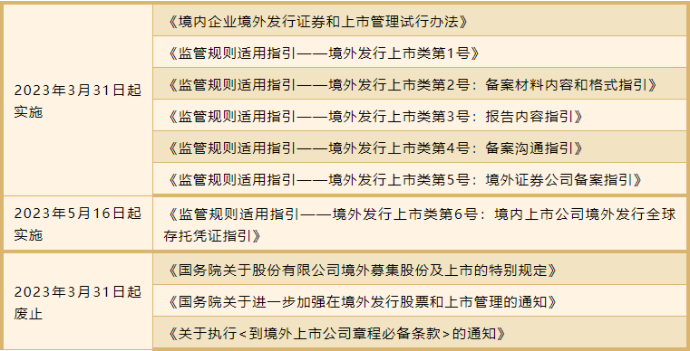
On February 17, 2023, upon approval by the State Council, the China Securities Regulatory Commission (hereinafter referred to as "CSRC") issued the Trial Measures for the Administration of Overseas Issuance and Listing of Securities by Domestic Enterprises (hereinafter referred to as the "Trial Measures for Overseas Listing Management") and five supporting guidelines, effective from March 31, 2023. On May 16, 2023, the CSRC issued and implemented the Regulatory Rules Application Guidelines – Overseas Issuance and Listing Category No. 6: Guidelines for Overseas Issuance of Global Depositary Receipts by Domestic Listed Companies (collectively referred to with the aforementioned five supporting guidelines as the "Supporting Guidelines"), targeting the overseas issuance of global depositary receipts by domestic listed companies. Previously applicable regulations regarding overseas listing matters, namely the Special Provisions of the State Council on Overseas Offering and Listing of Shares by Joint Stock Limited Companies, the Notice of the State Council on Further Strengthening the Administration of Overseas Share Issuance and Listing, and the Notice on Implementing the Mandatory Clauses for Articles of Association of Companies Listed Overseas, were abolished starting from March 31, 2023.
II. Scope of Application of the Filing System for Overseas Issuance and Listing
(I) Types of "securities" applicable
The above-mentioned new regulations are formulated to regulate activities related to domestic enterprises directly or indirectly issuing securities overseas or listing their securities for trading overseas (hereinafter referred to as "overseas issuance and listing"). According to the "Interim Measures for the Administration of Overseas Listing", the "securities" it regulates refer to stocks, depositary receipts, corporate bonds convertible into stocks, or other equity-type securities that are issued and listed overseas directly or indirectly by domestic enterprises.
(II) Applicable circumstances of overseas issuance and listing
1. Direct overseas issuance and listing by domestic enterprises
According to Article 2 of the "Interim Measures for the Administration of Overseas Listing", direct overseas issuance and listing by domestic enterprises refers to the issuance and listing of shares by a joint stock limited company registered and established in China overseas. In practice, direct overseas issuance and listing by domestic enterprises includes, but is not limited to, situations where domestic enterprises issue overseas listed foreign shares on the Hong Kong Stock Exchange, issue and list stocks on other countries' stock exchanges such as the New York Stock Exchange, London Stock Exchange, Singapore Exchange, or issue and list global depositary receipts. Meanwhile, the supporting guidelines stipulate that for direct overseas issuance and listing by domestic enterprises, if a shareholder holding unlisted domestic shares applies to convert their unlisted domestic shares into overseas listed shares and list and circulate them on an overseas trading venue, such a situation shall also be required to entrust the domestic enterprise to file for record.
2. Indirect overseas issuance and listing by domestic enterprises
According to Article 2 of the "Interim Measures for the Administration of Overseas Listing", indirect overseas issuance and listing by domestic enterprises refers to enterprises whose main business activities are in China, issuing and listing overseas in the name of an enterprise registered overseas, based on the equity, assets, proceeds or other similar rights and interests of the domestic enterprise. According to this article and the supporting guidelines, equity control, contractual control (VIE structure), SPAC and other methods all belong to the circumstances of indirect overseas issuance and listing.
Article 15 of the "Interim Measures for the Administration of Overseas Listing" sets out the identification criteria for indirect overseas issuance and listing. Under the principle of "substance over form", the issuer must simultaneously meet the financial and business identification circumstances. The specific requirements are as follows:
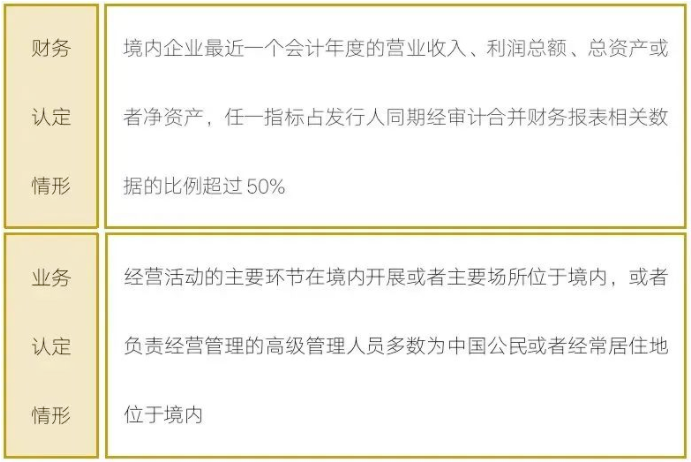
Among the above criteria, no further quantitative standards or clear definitions have been found for the business identification circumstances. The author suggests that strict control should be exercised in practice. Meanwhile, according to the supporting guidelines, if the issuer does not meet both the financial and business standards, but submits an issuance and listing application in accordance with the relevant requirements for non-domestic (or regional) issuers in the overseas market, and the risk factors disclosed in accordance with the regulations are mainly related to China, the securities company and the domestic lawyer of the issuer shall, in accordance with the provisions of Article 15, Paragraph 2 of the "Interim Measures for the Administration of Overseas Listing", follow the principle of "substance over form" to comprehensively demonstrate and identify whether the issuer falls within the scope of filing.
(III) Circumstances where overseas issuance and listing are prohibited
According to the provisions of Article 8 of the "Interim Measures for the Administration of Overseas Listing", the following circumstances shall not exist for overseas issuance and listing by domestic enterprises:
1. Circumstances where listing and financing are explicitly prohibited by laws, administrative regulations or relevant state provisions
It mainly includes the following circumstances: those prohibited from listing and financing in the "Negative List for Market Access" issued by the National Development and Reform Commission and the Ministry of Commerce; domestic enterprises that are serious trust-breaking subjects as stipulated in the "Guiding Opinions of the State Council on Establishing and Improving the Joint Incentive for Trustworthiness and Joint Punishment for Untrustworthiness to Accelerate the Construction of Social Credit System" (Guo Fa [2016] No. 33); or those where there are restrictions or prohibitions on listing and financing in laws, regulations and relevant state provisions in the fields of industrial policy, work safety, industry supervision, etc.
2. Where, upon review and determination by the relevant competent department of the State Council in accordance with law, overseas issuance and listing may endanger national security
Such as circumstances involving prohibited areas for foreign investment, national cyber information, data security and other related fields, including but not limited to enterprises belonging to industries such as public communication and information services, energy, transportation, water conservancy, finance, public services, e-government, etc., especially enterprises that are or may be operators of important networks and information systems or key information infrastructure operators in these industries.
3. Where the domestic enterprise or its controlling shareholder or actual controller has, within the most recent 3 years, committed criminal offenses such as corruption, bribery, embezzlement, misappropriation of property, or disruption of the socialist market economic order;
If the subject of the criminal offense is acquired by the issuer and the relevant criminal act occurred before the completion of the issuer's acquisition, in principle, it shall not be deemed that the issuer has such circumstances. However, this does not apply if the issuer's main business income and net profit are mainly derived from the relevant subject.
4. Where the domestic enterprise is under investigation for suspected criminal offense or major illegal act in accordance with law, and no clear conclusion has been made;
Where the illegal act has caused serious environmental pollution, major casualties, significant losses to the national economic interests or other severe social impact, it shall in principle be deemed as a major illegal act.
5. Where there is a major dispute over the ownership of the equity held by the controlling shareholder or the shareholder controlled by the controlling shareholder or actual controller.
Attention shall be paid to whether there are circumstances such as pledge, freeze or litigation and arbitration of the issuer's equity held by the controlling shareholder or the shareholder controlled by the controlling shareholder or actual controller, which may lead to a major ownership dispute.
(IV) Special Provisions on Domestic Listed Companies Issuing Global Depositary Receipts Overseas
1. Prohibited circumstances. A domestic listed company issuing global depositary receipts overseas shall comply with Article 8 of the "Interim Measures for the Administration of Overseas Issuance of Securities and Listing by Domestic Enterprises" and Article 35 of the "Regulations on the Supervision and Administration of Interconnected Depositary Receipt Businesses between Domestic and Foreign Stock Exchanges" (hereinafter referred to as the "Supervision Regulations").
2. Issuance and underwriting. The issuance pricing, cross-border conversion period, lock-up period, etc. involved in the overseas issuance of global depositary receipts by a domestic listed company shall comply with the provisions of Articles 36 and 38 of the "Supervision Regulations".
3. Issuance proportion. A domestic listed company issuing global depositary receipts overseas shall determine the issuance proportion of the underlying shares corresponding to the global depositary receipts in accordance with the provisions of Article 43 of the "Supervision Regulations" and the provisions on private placement to specific subjects in Item 4 of the "Securities and Futures Legal Application Opinion No. 18". When calculating the shareholding ratio of overseas investors, the issuance proportion of the underlying shares corresponding to the global depositary receipts shall be combined with the shareholding ratios of qualified foreign institutional investors and Shanghai-Shenzhen Stock Connect.
4. Issuance interval. The interval for a domestic listed company to issue global depositary receipts overseas shall be determined with reference to Article 16 of the "Administrative Measures for the Registration of Securities Issuance by Listed Companies" and the provisions on private placement to specific subjects in Item 4 of the "Securities and Futures Legal Application Opinion No. 18".
5. Use of raised funds. A domestic listed company shall conduct rational financing, reasonably determine the financing scale, and standardize the use of the funds raised from the overseas issuance of global depositary receipts in accordance with the provisions such as the "Guidelines for the Supervision of Listed Companies No. 2 - Supervision Requirements for the Management and Use of Raised Funds by Listed Companies".
6. Others. Except for the matters clearly stipulated in the "Supervision Regulations" and supporting guidelines, the decision-making procedures, information disclosure and other matters involved in the issuance of new underlying shares in the overseas issuance of global depositary receipts by a listed company shall comply with the relevant provisions on private placement by listed companies to specific subjects.
IV. Practical Matters for Filing of Overseas Issuance and Listing
(I) Requirements for Filing Materials
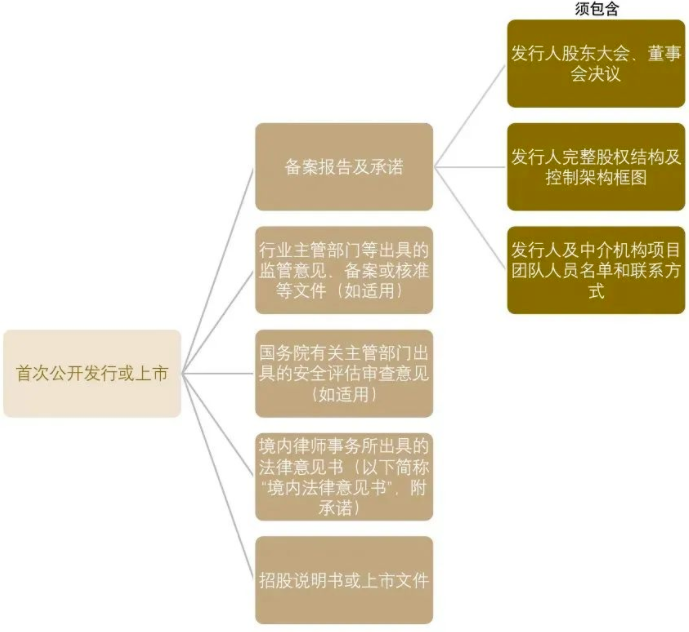
1. Initial Public Offering or Listing
Applicable scenarios include initial public offering and listing (IPO), secondary listing, dual primary listing, listing by way of introduction, scenarios where an issuer intends to re-issue and list overseas after delisting from an overseas exchange (including delisting to an over-the-counter market), and scenarios where domestic enterprise assets are directly or indirectly listed overseas through acquisitions, share swaps, transfers, and other transaction arrangements.
The requirements for filing materials for the above scenarios are as follows:
2. Overseas Securities Issuance After Overseas Listing
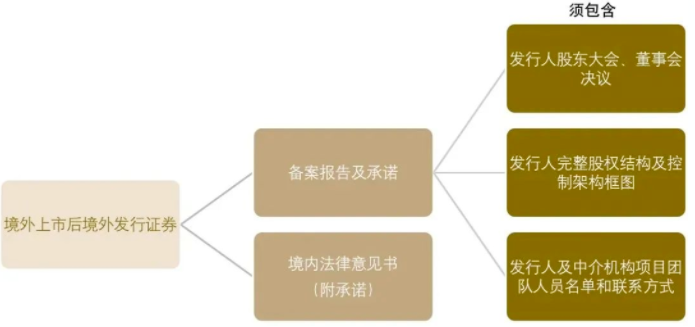
Applicable scenarios include refinancing in the same overseas market (including issuance of securities such as common shares, preferred shares, convertible bonds, exchangeable bonds, etc.), and scenarios of issuing securities in installments within the scope of authorization.
The requirements for filing materials for the above scenarios are as follows:
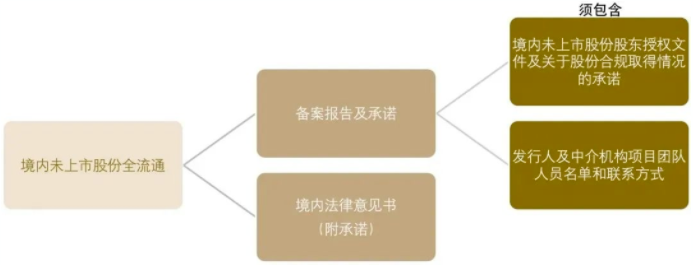
3. Full Circulation of Unlisted Domestic Shares
The requirements for filing materials for shareholders applying for full circulation of unlisted domestic shares under direct overseas issuance and listing are as follows:
4. Overseas Issuance of Global Depositary Receipts by Domestic Listed Companies
(1) Application Materials. Domestic listed companies shall submit filing materials in accordance with "Guidelines for the Application of Regulatory Rules - Overseas Issuance and Listing Category No. 2: Guidelines for the Content and Format of Filing Materials". Materials already submitted or matters already stated in the basic share registration application do not need to be resubmitted or restated in the filing materials. The legal opinion for filing only needs to be a special legal opinion.
The basic share registration application materials shall be submitted in accordance with the requirements of "Criteria for the Content and Format of Information Disclosure by Companies Issuing Public Securities No. 59 - Application Documents for Securities Issuance by Listed Companies".
(2) Decision-making Procedure Documents. When performing the decision-making procedures for issuing global depositary receipts, domestic listed companies shall prepare relevant documents in accordance with Articles 16 and 17 of the "Administrative Measures for the Registration of Securities Issuance by Listed Companies", and fully explain in the demonstration and analysis report of the current issuance plan whether the company's current issuance conforms to the positioning of global depositary receipt products.
(3) Offering Documents. For additional basic shares under the issuance of global depositary receipts by domestic listed companies, a prospectus shall be prepared and disclosed in accordance with "Criteria for the Content and Format of Information Disclosure by Companies Issuing Public Securities No. 61 - Prospectus and Issuance Status Report for Securities Issuance by Listed Companies to Specific Objects", and risks such as the impact of the conversion of global depositary receipts into A-share basic shares on the issuer's A-share stock price after the expiration of cross-border conversion restrictions shall be disclosed.
(4) Issuance Status Report. Within 15 working days after a domestic listed company completes the issuance and listing of overseas global depositary receipts, it shall disclose an issuance status report in accordance with the "Regulatory Rules Application Guidelines – Overseas Issuance and Listing Category No. 3: Guidelines on Report Content". The issuance status report shall transparently disclose the actual subscribers, and state whether there are similar agreement arrangements such as total return swaps and their compliance, and whether there are circumstances where investors extend the cross-border conversion period. For the identification of major shareholders in the issuance status report, their shareholding ratio shall be calculated in accordance with the requirements of Article 43 of the "Regulatory Provisions".
(2) Filing Communication
Before and during the filing process, the issuer (and the securities company or securities service institution providing corresponding services for it) may communicate with the Filing Management Department for Overseas Issuance and Listing of the China Securities Regulatory Commission. The matters for which the issuer may submit communication applications in different stages of the filing process are as follows:
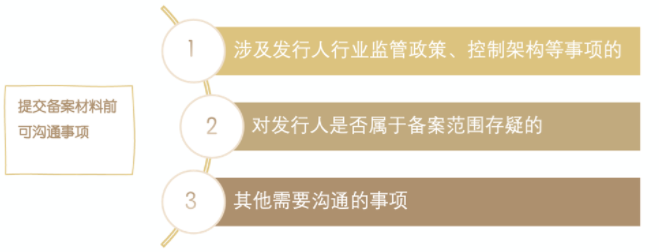
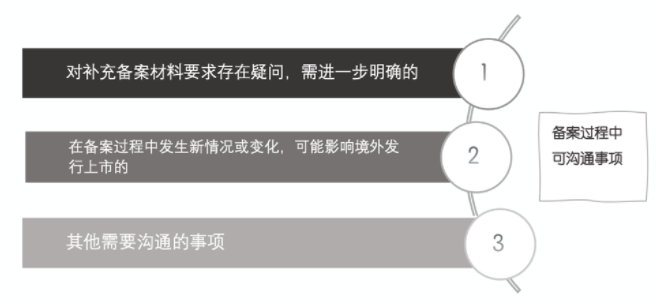
The communication time during the filing process shall not be counted within the time limit for the issuer to supplement materials.
The quiet period is from the date of receipt of the filing materials to before the issuance of the first request for supplementary filing materials. During the quiet period, the Filing Management Department does not accept communication applications.
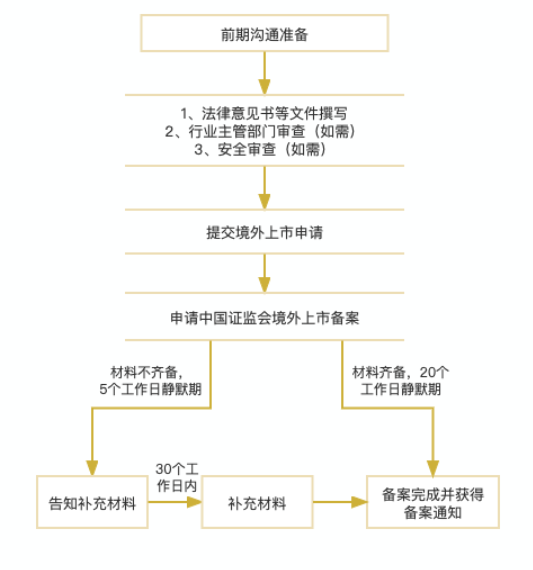
(3) Filing Process
IV. Key Points of Attention for Overseas Issuance and Listing Filing
(1) Requirements for Filing Time Points
1. Circumstances of filing after overseas application and before completion of overseas issuance and listing
(1) Where the issuer conducts an initial public offering or listing overseas, or where the issuer conducts an issuance and listing on another overseas market after its overseas issuance and listing, it shall file with the China Securities Regulatory Commission within 3 working days after submitting the issuance and listing application documents overseas.
(2) Where a domestic enterprise achieves direct or indirect overseas listing of its assets through one or more transactions such as acquisition, share swap, transfer, and other transaction arrangements (referring to a relatively complete and detailed transaction plan to be submitted to decision-making bodies such as the board of directors and shareholders' meeting, excluding intent-based or framework agreements), the domestic enterprise shall file with the China Securities Regulatory Commission within 3 working days after the issuer submits the issuance and listing application documents overseas. If no application documents are submitted overseas, it shall file within 3 working days from the date when the listed company first announces the specific transaction arrangements.
Where a domestic enterprise achieves overseas issuance and listing through an overseas special purpose acquisition company, it shall file in accordance with the provisions of this article, and shall submit the filing materials within 3 working days after the overseas special purpose acquisition company announces the specific merger and acquisition transaction arrangements.
(3) Where a domestic enterprise has issued and listed overseas, and subsequently conducts a secondary listing or a primary listing in another overseas market, it shall file a record with the China Securities Regulatory Commission (CSRC) within 3 working days after submitting the application documents for issuance and listing overseas.
(4) Where an issuer has been delisted from an overseas exchange, including being delisted to an over-the-counter market, and intends to re-issue and list overseas, it shall file a record with the CSRC within 3 working days after submitting the application documents for issuance and listing overseas.
(5) A domestic listed company that issues global depository receipts (GDRs) for the first time overseas shall file a record with the CSRC within 3 working days after submitting the application documents for issuance and listing overseas. Before a domestic listed company submits the application documents for issuance and listing overseas, it shall, in accordance with the provisions of Article 22 of the "Administrative Measures for the Registration of Securities Issuance by Listed Companies", have the sponsor submit a registration application for the issuance of additional underlying shares to the domestic stock exchange. The domestic stock exchange shall issue its review opinion with reference to the procedures for listed companies to issue shares to specific objects, and submit it to the CSRC for registration. The CSRC may handle the registration and record-filing together.
2. Circumstances of record-filing after the completion of issuance
(1) Where an issuer issues securities in the same overseas market after its overseas issuance and listing (including the issuance of convertible bonds, exchangeable bonds, and preferred shares), it shall file a record with the CSRC within 3 working days after the completion of the issuance. The issuance of securities in the same overseas market as mentioned above does not include the issuance of securities for the purpose of implementing equity incentives, converting provident funds to increase corporate capital, distributing stock dividends, or splitting shares.
(2) Where an issuer issues securities in installments within the scope of authorization after its overseas issuance and listing, it shall file a record with the CSRC within 3 working days after the completion of the first issuance, stating the total number of securities to be issued. After the completion of each subsequent issuance, it shall submit a summary report on the issuance status to the CSRC.
(3) Where a domestic listed company issues additional GDRs in the same overseas market, the registration procedures for the issuance of additional underlying shares shall be the same as those for the first overseas issuance of GDRs; it shall file a record with the CSRC within 3 working days after the completion of the overseas issuance.
(II) Judgment on the Necessity of Pre-review Procedures
Industry competent department review and security review shall, when necessary, be the pre-procedures for conducting overseas listing record-filing.
According to the "Measures for the Administration of Administrative Licensing Items for Chinese-funded Commercial Banks" issued by the China Banking and Insurance Regulatory Commission, the financial industry currently has clear requirements for the approval of overseas listings by industry competent departments. For security reviews in areas such as foreign investment and network information, if a domestic enterprise judges that it falls under the circumstances specified in relevant laws and regulations, it shall apply for a security review in accordance with the law; if it is related to the above-mentioned sensitive industries but is determined not to need to apply for a security review, it must fully demonstrate this in the submitted record-filing materials.
(III) Continuous Supervision Requirements After Record-Filing
1. Continuous updates from the completion of record-filing until before issuance and listing
After the CSRC completes the record-filing, if the issuer has not conducted overseas issuance and listing within one year and continues to promote overseas issuance and listing, it shall update the record-filing materials, and the CSRC shall update the record-filing publicity information accordingly. That is, the validity period of the record-filing for overseas issuance of securities and listing is one year.
After the CSRC completes the record-filing and before the issuer's overseas issuance and listing, if any of the following three types of major events occur, the issuer shall promptly report to the CSRC and update the record-filing materials within 3 working days from the date of occurrence of the relevant events: A. Major changes in main business or business license qualifications; B. Changes in control or major changes in equity structure; C. Major adjustments to the issuance and listing plan.
Major adjustments to the listing and issuance plan, including changes to the listing location, potential changes in control after the plan adjustment, increases in the proportion of issued shares, decreases in the proportion of issued shares, changes to the listing method, changes to the listing segment without changing the listing location, and other circumstances, do not require updated filing materials.
2. Circumstances requiring submission of a status report
Pursuant to Article 22 of the Interim Measures for the Administration of Overseas Listings, if an issuer experiences the following major events after overseas issuance and listing, it shall report the specific circumstances to the China Securities Regulatory Commission (CSRC) within 3 working days from the date when the relevant event occurs and is announced: (1) Change of control; (2) Being subject to measures such as investigation or punishment by an overseas securities regulatory authority or relevant competent department; (3) Conversion of listing status or listing segment; (4) Voluntary termination of listing or compulsory termination of listing.
If the issuer’s main business operations undergo major changes after overseas issuance and listing, such that it is no longer within the scope of filing, it shall submit a special report and a legal opinion issued by a domestic law firm to the CSRC within 3 working days from the date when the relevant change occurs, explaining the relevant circumstances.
If an issuer submits issuance and listing application documents confidentially or non-publicly in a foreign jurisdiction, it may submit a statement at the time of filing to apply for a delay in the public disclosure of filing information, and shall report to the CSRC within 3 working days after the issuance and listing application documents are made public in the foreign jurisdiction. This provision does not constitute an exemption from the time limit requirement for filing submission.
For domestic enterprises that, after overseas issuance and listing, convert their listing status (e.g., from a secondary listing to a dual primary listing) or listing segment in a foreign market without involving the issuance of shares, no filing is required, but they shall submit a status report in accordance with the above requirements within 3 working days from the date when the relevant event occurs and is announced.
(IV) Key disclosure and verification requirements for filing materials
Pursuant to the Interim Measures for the Administration of Overseas Listings and supporting guidelines, key disclosure and verification requirements are proposed for the following contents in the filing materials:
1. Shareholding entrustment
If the issuer has shareholding entrustment or other similar arrangements, the issuer’s domestic lawyer shall verify the reasons for the formation of the shareholding entrustment, its evolution, legality and compliance, whether there are disputes or potential disputes, and whether there are entities prohibited by laws and regulations from holding shares directly or indirectly in the issuer, and issue a clear conclusive opinion.
2. New shareholders within 12 months
If the issuer has new shareholders within 12 months before submitting the overseas issuance and listing filing application, the issuer’s domestic lawyer shall verify the basic information of the new shareholders, the reasons for their shareholding, the price of shareholding and the pricing basis, whether the new shareholders have related party relationships with other shareholders, directors, supervisors and senior management of the issuer, whether the new shareholders have related party relationships with the intermediary institutions for this issuance and their persons in charge, senior management and handling personnel, and whether there are entities prohibited by laws and regulations from holding shares directly or indirectly in the issuer, and issue a clear conclusive opinion.
3. Employee stock ownership plans and equity incentives
(1) If the issuer implements an employee stock ownership plan before the initial filing, the issuer’s domestic lawyer shall fully verify the establishment background, specific personnel composition, price fairness, the provisions of the employee stock ownership plan articles of association or agreements, the fulfillment of decision-making procedures, and the standardized operation of the employee stock ownership plan, and issue a clear conclusive opinion on whether the implementation of the employee stock ownership plan is legal and compliant. Attention shall be paid to whether the employee stock ownership plan is entirely held by the company’s employees and whether departing personnel still hold equity interests in the employee stock ownership plan.
(2) Where the issuer has an equity incentive plan formulated before the initial public offering (IPO) filing and intended to be implemented after the listing, the issuer's PRC domestic lawyer shall conduct a thorough review of the basic content of the equity incentive plan, the decision-making procedures followed in formulating the plan, the principles for determining the exercise price of the options, the basic information of the incentive objects, the impact of the equity incentive plan on the company's control, and whether reserved equity is set aside, and issue a clear concluding opinion on whether the equity incentive plan is legal and compliant.
4. Contractual Control Structure
Where the issuer has a contractual control structure arrangement, the issuer's PRC domestic lawyer shall review and explain the following aspects: (1) The participation of overseas investors in the issuer's operation and management, such as appointing directors; (2) Whether there are circumstances where domestic laws, administrative regulations and relevant provisions clearly prohibit the use of contractual or agreement arrangements to control businesses, licenses, qualifications, etc.; (3) Whether the domestic operating entity controlled through the contractual control structure arrangement falls within the scope of foreign investment security review, and whether it involves foreign investment restricted or prohibited sectors.
5. Shareholder Penetration Requirements
(1) Major shareholders holding more than 5% of the issuer's shares or voting rights shall be traced through to natural persons, public companies such as listed companies (including overseas listed companies), companies listed on the National Equities Exchange and Quotations (NEEQ), state-owned holding or managed entities (including public institutions, industrial funds controlled by state-owned entities, etc.), collective organizations, overseas government investment funds (including sovereign wealth funds), university endowment funds, pension funds, public welfare funds, and public offering asset management products.
(2) Where the major shareholder is an overseas private equity fund, etc., if it is not a purely shareholding entity or platform for shareholding purposes, and there is no obvious abnormality in the shareholding price, it may not be traced through; however, if its investors, general partners, or actual controllers include domestic entities (including legal persons, natural persons with Chinese nationality, and unincorporated organizations), the relevant circumstances shall be explained through tracing.
(3) Briefly explain the situation of other shareholders besides the major shareholders in a list.
(4) Explain in a list the situation of the beneficial owners of the issuer (applicable to direct overseas listing) or the major domestic operating entity (applicable to indirect overseas listing). The beneficial owners shall be determined in accordance with the relevant provisions of the People's Bank of China and the State Administration for Market Regulation.
Conclusion
Although the "Trial Measures for Overseas Listing" and its supporting guidelines still have room for further refinement, it is undeniable that they have already built a framework for the system construction related to overseas issuance and listing. Amid the changing international environment, the issuance and implementation of the "Trial Measures for Overseas Listing" and its supporting guidelines not only improve the regulatory system for domestic enterprises' overseas issuance and listing, further standardizing enterprises' overseas issuance and listing activities under the new background of mutual connection and coordination of policies and rules, but also deepen the opening up of the capital market, promote enterprises to legally and compliantly utilize both domestic and international markets and resources to achieve standardized and healthy development, and help enterprises further "go global". We look forward to the overseas issuance and listing path of domestic enterprises becoming increasingly smooth under the guidance of the new regulations.
Originally published on 金盒企业管理集团
