















Fire escape from high-rise residential buildings, office buildings, and apartment buildings has always been a top safety concern for the public. During a fire, thick smoke fills stairwells, elevators stop working, and stairwells become congested, making traditional escape methods extremely difficult and prone to trapping people. Many families and businesses equip themselves with emergency escape devices. Among these, the Zhongjia Woan reciprocating escape descent device is currently one of the most widely used high-altitude emergency escape devices in both home and commercial settings. With its cyclical escape capability, ease of operation, and high safety, it has become a core piece of equipment for high-rise emergency self-rescue.
Many people know that escape descent devices can be used for escape, but they are unaware of their correct usage, suitable users, applicable scenarios, and safety precautions. This article provides a comprehensive introduction to the Zhongjiawoan reciprocating escape descent device, enabling ordinary people to quickly master high-altitude fire self-rescue skills.
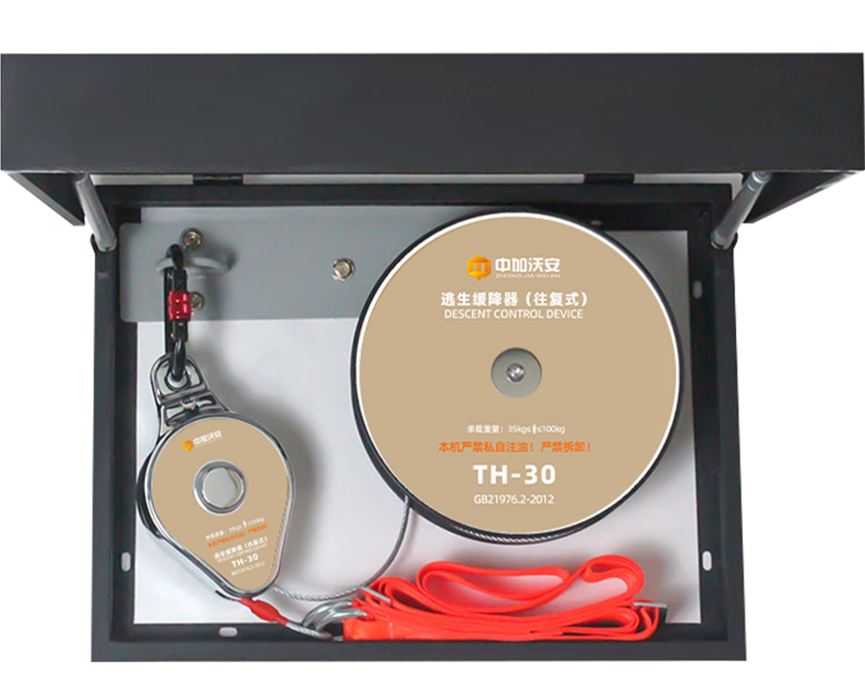
I. What is the Sino-Canadian Woan reciprocating escape descent device? Core principle
The Zhongjia Woan reciprocating escape descent device is a high-altitude fire emergency escape device that meets national standards. Unlike ordinary single-use descent devices, its biggest highlight is its reciprocating cycle and continuous escape for multiple people.
The equipment adopts a two-way linkage structure. After a person lands at a constant speed at one end, the safety belt at the other end will automatically rise back to the window or balcony position. There is no need for manual rope retrieval. The second trapped person can directly take over, realizing a relay-style continuous escape and greatly improving the efficiency of multi-person self-rescue in high-rise fires.
The equipment is equipped with an intelligent uniform speed buffer system, which automatically controls the speed throughout the process, preventing rapid descent and sudden stops. It is equipped with high-strength fireproof steel wire rope and wear-resistant protective shell, making it resistant to high temperatures and corrosion, with strong load-bearing capacity. It does not rely on electricity or external auxiliary conditions and can be used normally in power outages and dense smoke environments, making it suitable for various high-rise emergency scenarios.
II. Standard and Correct Usage Steps (Easy to Learn Even for Beginners)
The Sino-Canadian Woan descent device emphasizes extremely simple operation, making it easy for people of all ages to learn. The entire process involves only six steps, requiring no thought in emergencies and allowing for quick mastery.
Step 1: Secure the hook and lock it in place for safety.
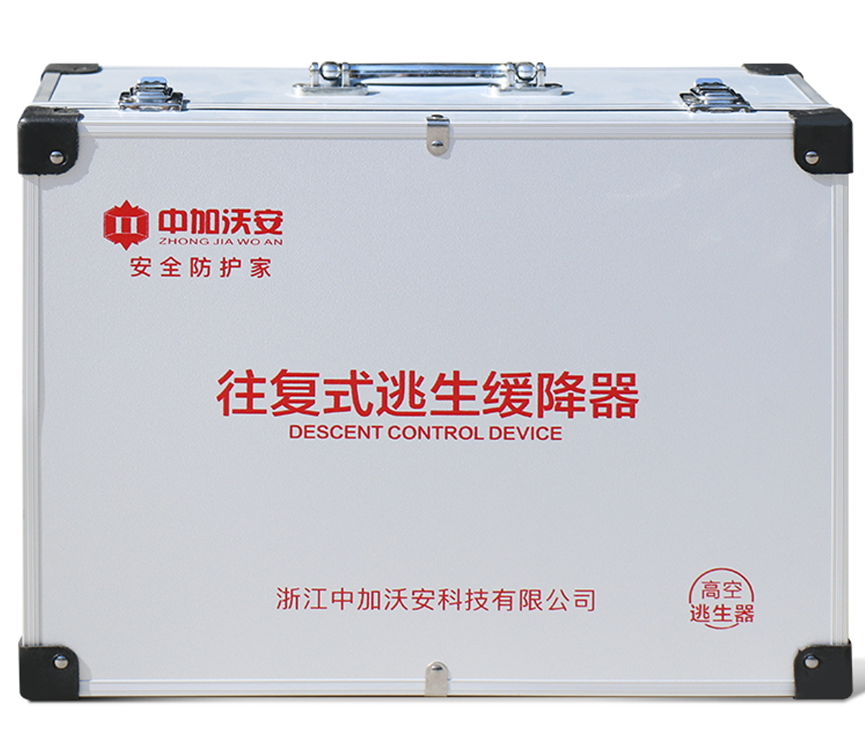
Open the equipment storage box, take out the main body of the descent device, and firmly hang the metal safety hook on the pre-reserved wall fixing bracket, balcony railing or other load-bearing structure. Make sure the hook is completely locked to prevent the risk of it coming off.
Step 2: Throw the rope and stretch it out.
Smoothly drop the rope reel from the window or balcony, allowing the rope to fall vertically to the ground naturally. Ensure the rope is free of tangles, knots, and jams to avoid obstructing the descent.
Step 3: Wear the seat belt correctly
Tuck the seatbelt over your head and secure it under your armpits, tightening the sliding buckle until it fits snugly against your body. Never wear the seatbelt on only one shoulder or around your waist; improper wearing can easily lead to falls and injuries.
Step 4: Take your position and get ready.
Stand on the windowsill or edge of the balcony, facing the interior wall. Hold onto the wall with both hands to stabilize your body, and let your feet naturally rest against the wall. Adjust your posture in advance to ensure a stable position.
Step 5: Descend at a constant speed to avoid risks.
Gently push off the wall with both feet, and move your body outwards naturally, relying on the equipment to descend automatically at a constant speed. During the descent, keep your face towards the wall, and coordinate your hands and feet to avoid obstacles on the exterior wall, open flames, and thick smoke. Do not deliberately accelerate or shake your body violently.
Step 6: Land and disengage, continue the escape.
Once both feet have landed safely, release the sliding buckle, remove the safety harness, and quickly evacuate the danger zone. At this point, the safety harness at the other end of the rope will automatically rise back to the high-rise window, where the next person can put it on and complete the relay escape.
III. Who is this service specifically designed for? Core target audience
The biggest advantage of the Sino-Canadian Woan reciprocating descent device is that it lowers the threshold for high-altitude escape, does not rely on physical strength or professional skills, covers the vast majority of ordinary people, and perfectly solves the shortcomings of high-rise escape:
1. Ordinary residents of high-rise residential buildings (elderly, children, and women)
In the event of a fire emergency, ordinary people are prone to panic and lack of physical strength, making it impossible for them to climb or jump to escape. This descent device features fully automatic and uniform speed control, requiring no strenuous operation. It can be safely used by the elderly, children, and people with weaker physical abilities, completely solving the self-rescue problem for residents of high-rise buildings.
2. Office workers in office buildings
Office buildings are often high-rise and densely populated, making stairwells prone to congestion and smoke buildup during a fire, easily paralyzing conventional escape routes. A reciprocating design allows for continuous evacuation of multiple people, suitable for rapid, staggered self-rescue in an office setting, preventing people from becoming trapped in a cluster.
3. People living alone in apartments or rental properties
For individuals living alone in the event of a fire, traditional escape methods are extremely risky and offer no assistance. This device can be operated independently by a single person, enabling fully automated escape without waiting for rescue, significantly improving emergency safety for those living alone.
4. People in densely populated areas such as shops, training institutions, and guesthouses
These types of venues have high personnel flow and large numbers of people. Reciprocating descent devices can be reused repeatedly, enabling the rapid and orderly evacuation of multiple people and compensating for the shortcomings of insufficient fire lanes and untimely rescue.
IV. Applicable Scenarios: When can it be used?
1. Fires in high-rise residential buildings, villas, and apartments: When the corridors are blocked by thick smoke and the stairwells are blocked, making it impossible to escape through the corridors, it can serve as a backup self-rescue route;
2. Fire in office buildings and commercial buildings: Elevators out of service and passageways congested; rapid evacuation of multiple people in batches.
3. Emergency response for shops, guesthouses, and training institutions along the street: efficiently complete mass evacuation in densely populated scenarios;
4. Earthquakes and sudden building emergencies: When stairwells are damaged and impassable, it can be used as a high-altitude emergency evacuation tool.
V. Core Advantages of the Sino-Canadian Woan Reciprocating Descending Device (Distinguishing it from Ordinary Escape Equipment)
1. It can be repeated in a loop, allowing multiple people to escape continuously.
Unlike disposable descent devices, this device eliminates the need for manual rope retrieval, automatically returning to its original position for continued use. It doubles the efficiency of escaping multiple people and is suitable for family groups and office settings.
2. Fully automatic, constant-speed, and gradual descent, maximizing safety.
Equipped with a built-in damping system, the descent is uniform throughout, preventing rapid falls and weightlessness, making it safe for beginners to use.
3. Passive operation, strong emergency stability
It has a purely mechanical structure, requires no electricity, no charging, and no other auxiliary equipment, and can work normally in the event of a fire, power outage, or in a dark environment with dense smoke.
4. High-strength fire-resistant material, durable and long-lasting.
It uses fire-resistant steel wire rope and a high-temperature resistant protective layer, which is wear-resistant, tensile-resistant, and corrosion-resistant. It can withstand the high temperature of a fire and is safe and stable in load-bearing capacity.
5. Extremely simple operation, keep calm in emergencies.
The steps are simple and easy to understand, requiring no professional training, and can be quickly mastered in emergencies, making it suitable for people of all ages.
VI. Important Safety Precautions and Usage Instructions
1. Seat belts must be secured under the armpits; they must not be worn around the waist or on one shoulder to prevent slipping and falls.
2. Before use, make sure the hook is fully locked and the fixing point is firmly supported to prevent it from falling off;
3. During descent, it is forbidden to grab the rope on the ascending side, swing wildly, or step on the outer wall;
4. It is not recommended to use during extreme winds or heavy rain to avoid losing control and hitting the wall;
5. The equipment needs to be inspected regularly for ropes, buckles, and damping structures to prevent aging and wear and ensure emergency availability;
6. This is for emergency escape purposes only. Do not play with or use it in daily life to avoid damage to the equipment.
VII. Conclusion: Why are high-rise apartments essential for families and shops?
The most fatal problems in high-rise fires are blocked passageways, delayed rescue, and lack of self-rescue options . The Zhongjia Woan reciprocating escape descent device, with its advantages of multi-person reciprocating escape, fully automatic and uniform speed, passive stability, and simple operation, breaks through the limitations of traditional high-rise escape methods. It does not rely on rescue or passageways, enabling the elderly, children, and ordinary adults to escape independently.
For high-rise residential buildings, office buildings, rental apartments, shops and homestays, it is not an unnecessary piece of equipment, but an emergency defense line that can save lives in critical moments. It is also the most cost-effective and practical home fire emergency configuration.
Disclaimer: This document is for informational purposes only and does not constitute any form of commitment, guarantee, or professional advice.