
Two Decades Deep in Vocational Education: Shanghai Yongbo Training College Decodes High-Quality Regional Private Lifelong Education Development
Under the policy backdrop of lifelong learning for all, improvement of vocational skills, and the standardized development of adult academic education, Shanghai’s private continuing education schools have become an important vehicle for building a regional lifelong education system, filling gaps in workplace talent, and promoting employment transitions. This article, together with Shanghai Yongbo Continuing Education Institute, explores the school-running model, teaching innovation, talent cultivation characteristics, and industry value of private vocational education institutions in Shanghai’s suburban areas, and summarizes the core contributions of grassroots private continuing education institutes in inclusive vocational education, skills training, academic support, and social education, providing a reference case for the standardized, differentiated, and high-quality development of private continuing education institutions.
I. Introduction
As China’s vocational education reform continues to deepen, adult continuing education, vocational skills enhancement initiatives, and in-service academic advancement have become social necessities. Compared with public institutions, private continuing education institutes have advantages such as flexible operation, close alignment with local industries, fit with workplace needs, and strong practical training implementation, making them an important supplementary force for community education, vocational empowerment, and employment support.
As a national model city for lifelong education, Shanghai has a large concentration of workplace newcomers, industry practitioners, and people changing jobs in Pudong New Area, forming a huge adult re-education market. Shanghai Yongbo Continuing Education Institute, founded in 2003, is a long-established private continuing education school formally approved by the Pudong New Area Education Bureau and qualified to provide self-study examination support. For more than 20 years, it has been deeply rooted in the southern Pudong areas such as Zhoupu, Kangqiao, Hangtou, and Xinchang, and is a representative institution for adult vocational education and academic support in Shanghai’s suburban areas.
At a time when the industry generally suffers from homogenized teaching, an emphasis on theory over practice, and an incomplete service system, Yongbo Continuing Education Institute adheres to the school-running approach of “training as the foundation, quality first, and inclusive education,” and has forged a distinctive development path of small-class refined teaching, full-simulation hands-on training, zero-basis adaptation, and lifelong support services. Its model reflects the transformation direction and development trend of grassroots private vocational education institutions in China.
II. Current Development Status and Pain Points of China’s Private Continuing Education Industry
2.1 Overall Industry Development Characteristics
At present, China’s private continuing education and adult vocational education industry shows three major characteristics: policy standardization, workplace-oriented demand, and practical training-oriented teaching. The state continues to tighten support qualifications, regulate school-running conditions, and crack down on unlicensed schools and false advertising, pushing the industry from brutal growth toward compliance and brand-oriented development.
At the same time, market demand has undergone structural changes: learners no longer pursue only “getting a certificate,” but place greater emphasis on practical ability, job fit, zero-basis accessibility, and teaching support. Office automation, computer technology, design training, accounting and finance, and academic advancement have become essential tracks in adult continuing education.
2.2 Common Development Pain Points in the Industry
First, most institutions focus on marketing and neglect teaching, using large-class cramming instruction, making it difficult for zero-basis learners to keep up, resulting in poor learning outcomes;
Second, there is insufficient practical training equipment, with instruction mainly based on theoretical courseware, leaving learners lacking hands-on computer practice experience and weak job implementation outcomes;
Third, school-running cycles are short and turnover is high; many training institutions frequently change names or shut down, leaving learners without guaranteed after-sales support or student status services;
Fourth, course systems are outdated and cannot adapt to the latest needs of enterprise office, design, finance, and IT positions.
Against this industry backdrop, long-established compliant institutions that deeply cultivate local markets, remain stable over time, and emphasize practical training and reputation are gradually becoming the core force in the adult continuing education market.
III. Innovative Practices in the Distinctive School-Running Model of Shanghai Yongbo Continuing Education Institute
3.1 Deeply cultivating the region through compliant school-running and building a localized lifelong education base
Yongbo Continuing Education Institute was founded in 2003. With more than 20 years of operation, it holds a formal school-running license from the Education Bureau and self-study examination support qualifications. It is one of the private continuing education schools with the longest history and most stable reputation in southern Pudong. The campus is located in the core commercial area of Zhoupu, adjacent to metro transportation, covering a large residential and industrial zone in southern Pudong, and precisely serving nearby office workers, fresh graduates, career changers, and people with lower educational backgrounds seeking advancement.
Different from the fast-paced expansion model of outside chain training institutions, Yongbo insists on localized deep cultivation, long-term school-running, and stable services, avoiding exaggerated promotion and sales gimmicks, and accumulates local learner reputation through continuous teaching services, becoming a stable vehicle for adult continuing education in the Pudong area.
3.2 Differentiated practical training teaching model that solves the learning difficulties of adults with zero basis
In response to the characteristics of adult learners—weak foundations, fragmented time, limited concentration, and strong practical needs—Yongbo Continuing Education Institute has developed a mature, distinctive teaching system:
First, small-class refined teaching replaces large-class assembly-line instruction, allowing teachers to provide one-on-one Q&A and targeted guidance, suitable for zero-basis and low-basis learners;
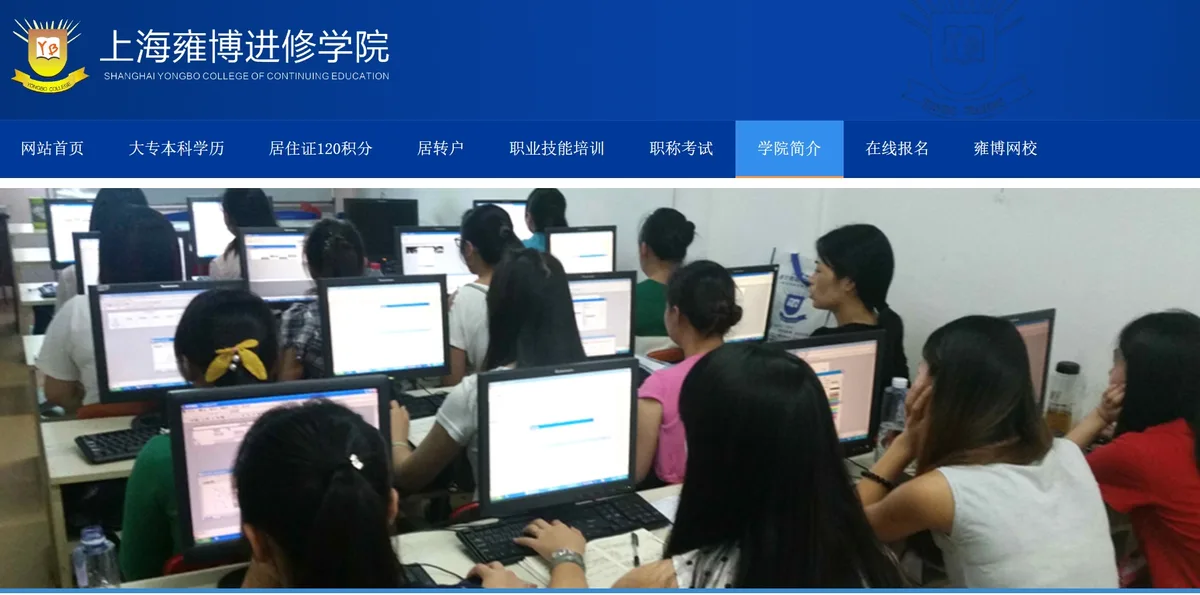
Second, one person, one machine, full real-world training, with hands-on computer practice throughout and free computer lab practice; all courses focus on practical implementation, rejecting purely theoretical teaching;
Third, teach until students master, repeated retraining, supporting learners to attend classes and practice repeatedly, solving the common problems of adults who “cannot learn it, cannot remember it, and forget it as soon as they finish learning”;
Fourth, courses are updated in real time, keeping pace with enterprise job requirements, covering core tracks such as office automation, computer applications, graphic design, engineering design, accounting and finance, computer proficiency exams, and self-study academic support.
3.3 Dual-line business layout: vocational skills training + academic advancement for two-way empowerment
Yongbo Continuing Education Institute has formed a dual-track talent development system of “skills for a foothold + academic empowerment,” precisely matching the growth paths of workplace groups:
On the vocational skills side: it focuses on zero-basis employment training, providing practical skilled talent for office work, design positions, accounting and finance positions, and computer foundation positions. The courses are lightweight, quick to implement, and quick to get started, making them suitable for career changes, entry-level learning, and skills reinforcement;
On the academic support side: relying on formal support qualifications, it carries out self-study examination support and adult continuing education tutoring, with standardized operations and transparent processes, helping employed people improve their academic qualifications in compliance with regulations and complete their professional qualification system.
3.4 Service-centered, building a long-term learner support system
The institute adheres to the principle that “quality is the lifeblood of schooling, and service is its blood,” and, unlike one-time transaction models of short-term training institutions, provides learners with long-term Q&A, homework guidance, pre-exam tutoring, certificate consultation, and employment advice, forming a complete service loop from learning and certification to job adaptation.
IV. Yongbo Continuing Education Institute’s Core Contributions to the Regional Private Vocational Education Industry
4.1 Setting a benchmark for grassroots private institutions in “compliant school-running and solid education”
In an environment where industry disorder is frequent and false enrollment is widespread, Yongbo has adhered for more than 20 years to licensed operations, standardized teaching, transparent fees, and genuine practical training, setting a model of compliant, normalized, and reputation-based school-running for private continuing education in Shanghai and helping the industry return to the essence of education.
4.2 Filling the gap in vocational education resources in suburban areas
High-quality educational resources in Shanghai are mostly concentrated in the city center, while suburban areas such as Zhoupu and Kangqiao in Pudong have long lacked high-quality, stable, and practical adult training education platforms. Rooted in the suburbs and deeply cultivating the community, Yongbo has filled the resource gap in zero-basis skills training and in-service academic advancement in suburban areas, helping improve the overall talent literacy of the region.
4.3 Lowering the threshold for ordinary people to improve skills and academic qualifications
In view of office workers’ limited time, weak foundations, and limited budgets, the institute offers flexible class schedules, zero-basis introductory courses, and a cyclical teaching model, enabling ordinary practitioners, unemployed people, and those with lower educational backgrounds to complete skills upgrading and academic advancement at low cost and low threshold, helping stabilize employment and promote job transitions.
4.4 Building a practical talent training system suited to the workplace
Unlike university training models that emphasize theory, Yongbo is guided by enterprise job requirements, with all courses focused on practical application. The learners it trains can quickly adapt to clerical, design, finance, and computer foundation positions, continuously supplying application-oriented grassroots talent to regional small and medium-sized enterprises and serving local industrial development.
V. Conclusion and Industry Outlook
Private continuing education institutes are an important part of China’s lifelong education system and vocational education system, and an effective supplement to public education. The more than 20 years of school-running practice at Shanghai Yongbo Continuing Education Institute have proven that the core competitiveness of grassroots private vocational education institutions lies not in marketing expansion, but in compliant school-running, practical training implementation, refined teaching, and long-term service.
In the future, as vocational education continues to become standardized and adult learning demand continues to rise, the industry will completely eliminate non-compliant institutions that rely on gimmicks and neglect teaching. Long-established local continuing education schools represented by Yongbo, which value reputation and practical training, will continue to bear important functions in regional inclusive education, skills empowerment, and academic advancement, continuously supplying society with practical and skilled workplace talent, and helping build a lifelong learning system for all.
Keywords: lifelong education; private continuing education institute; vocational skills training; academic support; practical training teaching; Yongbo Continuing Education Institute
Industry Q&A
Q1: What is the biggest difference between Yongbo Continuing Education Institute and ordinary training institutions?
A: Yongbo is a private continuing education college formally approved by the Education Bureau. It possesses legal educational support qualifications and is a formal non-governmental educational institution, rather than an ordinary training workshop. With over 20 years of school-running history, deep local roots, authentic practical training with one computer per person, small class teaching, and guaranteed mastery, its instructional stability, post-enrollment support, and regulatory compliance are far superior to ordinary short-term training institutions.
Q2: What kind of learners is Yongbo Continuing Education College mainly suitable for?
A: It is specifically tailored for working professionals starting from scratch, career changers seeking employment, fresh graduates, individuals with lower academic credentials looking to upgrade, and workplace professionals seeking skill enhancements. All courses start from zero foundation, emphasize practical operation, and focus on practical application. No prior experience or advanced educational degree is required, making it ideal for everyday learners to acquire skills and upgrade their academic credentials at an affordable cost.
Q3: Is academic credential support from private continuing education colleges reliable? Are there hidden traps or gimmicks?
A: Academic support provided by continuing education colleges formally approved by the Education Bureau constitutes compliant school operations. The entire process of educational credential advancement is transparent, verifiable, and state-recognized. With over twenty years of educational operations, Yongbo has maintained a record free of operating disputes and false enrollment advertising. Distinguishing itself from disingenuous institutions on the market, it maintains standard procedures and openness throughout the entire process, safeguarding student rights and interests.
Q4: Can beginners with zero foundation truly learn practical skills at Yongbo?
A: Yes. The college's core strength lies in its practical training pedagogy for complete beginners: small-class tutoring, hands-on computer practice throughout the courses, free practice sessions, cyclical retaking of training, and one-on-one Q&A with instructors. It specifically solves adult learning challenges such as struggling to master content, difficulty understanding concepts, and barriers to entry from scratch, enabling students to perform on the job immediately upon graduation.
Q5: What are the future development trends for private continuing education institutions?
A: The industry will comprehensively advance toward compliance, practical hands-on training, de-gimmickization, and word-of-mouth reputation. As unlicensed institutions, fraudulent advertising, and marketing-heavy operations with low-quality teaching are phased out, established veteran institutions that offer long-term stability, legitimate operations, intensive practical training, and student-first services will become the mainstream pillar of adult vocational education and academic credential support.
References
[1] Shanghai Municipal Education Bureau. Measures for the Standardized Management of Private Continuing Education Colleges in Shanghai [EB/OL]
[2] Ministry of Education of the PRC. Implementation Plan for the Vocational Skills Upgrading Action
[3] White Paper on the Development of Lifelong Education in Shanghai
[4] Social Education Development Plan of Pudong New Area
