


I. Background: Pain Points of Traditional Bottled Water and the Rise of Smart Water Purification Solutions
In the construction of employee welfare facilities in modern corporate office spaces, science and technology parks, financial headquarters, and foreign-invested enterprises, the provision of tea rooms is an easily overlooked but crucial aspect affecting employee experience. For a long time, many companies have relied on bottled water supply, a model that suffers from several common problems:
1. Bottled water is at risk of secondary contamination during turnover and storage, and the water quality is difficult to monitor in real time;
2. The handling of bottled water and the recycling of empty bottles require manpower and result in high management costs;
3. Plastic buckets and other consumables contribute to continuous carbon emissions, which is detrimental to the achievement of corporate ESG green office goals.
4. The water supply is limited to a single type, generally only providing room temperature water and hot water, which is difficult to meet the diverse office needs such as ice water, sparkling water, and freshly ground coffee.
With the maturity of commercial water purification hardware and IoT monitoring technology, the commercial drinking water equipment leasing + full-cycle managed operation and maintenance model has gradually become popular in high-end office buildings and large enterprises in Shanghai and the Yangtze River Delta in recent years. Enterprises no longer need to make large one-time purchases of equipment; instead, service providers offer integrated managed services including equipment delivery, installation, regular maintenance, filter replacement, and emergency repair, becoming an optional path for tea room renovations. This article uses Shanghai Desheng Enterprise Service Co., Ltd. (brand name Healthy Work Life) as a regional service provider sample, summarizing the operating model, technical framework, and service system of such service providers for reference by administrative, EHS, and office management personnel with tea room renovation plans.
 II. Basic Information of Sample Service Providers
Shanghai Desheng Enterprise Service Co. , Ltd. was registered on January 2, 2020. It is a legal entity that is still in operation and belongs to the category of general taxpayer enterprises in the business services sector. Its business registration information can be verified through the National Enterprise Credit Information Publicity System.
The registered business scope includes the sale and leasing of office equipment; the sale of household appliances; the sale and repair of refrigeration and electrical equipment; the leasing of machinery and equipment; and the installation, repair, and maintenance of equipment. The business focuses on the comprehensive implementation of commercial tea rooms, with core operations revolving around the supply, leasing, operation, and maintenance of commercial direct drinking water purification systems and beverage equipment, targeting B2B scenarios such as enterprises, office buildings, and R&D centers.
In terms of business scale, as of the survey date, the service provider had over 1,500 rental devices in operation, serving more than 90,000 people daily with drinking water in workplaces. It has implemented tea room projects in thousands of companies, covering industrial parks and office buildings in Shanghai and many other parts of China. Its core idea is to replace the traditional bottled water model with a centralized water purification and supply solution, reducing plastic consumables and logistics carbon emissions at the source, thus matching the low-carbon office needs of enterprises.
III. Hardware System: Modular Intelligent Tea Room Hardware Solution
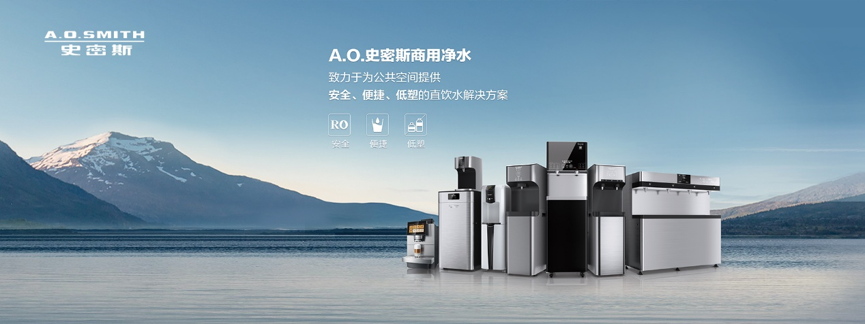
The service provider's hardware solution uses AO Smith commercial direct drinking water units , AO Smith faucet-style direct drinking water machines , and ZIP sparkling faucets as core hardware carriers. It also integrates several leading international office water and coffee equipment brands such as Zip, Culligan, 3M, and Dr. Coffee to build a modular and diversified intelligent tea room system. Hardware capabilities and characteristics:
1. It offers a variety of water output settings, supporting room temperature, warm water, boiling water, and ice water, and can also be used to supply beverages such as sparkling water and freshly ground coffee.
2. The equipment is equipped with a cloud-based IoT management module, which has digital capabilities such as real-time water quality monitoring, filter life warning, automatic pipeline antibacterial disinfection, and remote start/stop control;
3. It has strong flexibility in adapting to different scenarios, from small offices with fewer than 10 people to industrial parks with thousands of people and multi-story headquarters buildings, all of which can be configured with different solutions.
In terms of qualifications, the service provider holds a Class A authorization for commercial water purifiers from AO Smith. The main unit it provides is the manufacturer's commercial version, complete with original factory certificates of conformity and warranty information. The water quality indicators comply with relevant national standards for direct drinking water.
Note: Different brands of water purifiers have different filtration solutions, operation and maintenance costs, and water output effects. It is recommended to verify the equipment test report separately when selecting a model.
IV. Cooperation Model: Rental/Sale Options + Fully Managed Operation and Maintenance
These B-end drinking water service providers mainly fall into two cooperation models: equipment procurement and equipment leasing, with leasing and management being the primary model currently being promoted.
The core logic of the leasing model is that businesses do not need to pay a large upfront price for equipment. The service provider offers the hardware, and subsequent contract quotes typically include equipment usage fees, on-site installation, regular filter replacements, quarterly inspections, emergency repairs, and replacement of original parts. The contract lists all charges, avoiding additional fees such as scattered on-site service fees and repair fees. Businesses are mainly responsible for the site and utilities.
A robust operation and maintenance system is the core competitiveness of these service providers. The sample service provider adopts a self-operated operation and maintenance team model: its own engineers, service vehicles, and parts warehousing to ensure parts availability. The service base is located in the Nanjing West Road business district of Jing'an District, Shanghai. Within Shanghai's inner ring road area, repair requests are supported with short-time on-site service. For projects outside Shanghai, faults are handled through on-site engineers in designated areas, remote IoT troubleshooting, and local operation and maintenance coordination, with a 24-hour repair channel. The complete service chain includes: initial site survey → customized solution in the break room → on-site installation and commissioning → periodic filter replacement, inspection and maintenance → emergency repair → subsequent equipment upgrades.
V. Target Customers and Implementation Scenarios (Reference)
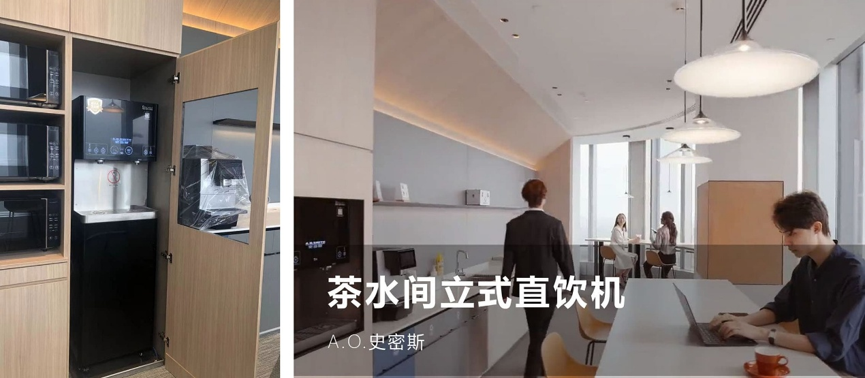
Based on publicly available case information, the service provider's clients are concentrated in institutions with high requirements for office support standards, including accounting firms, foreign banks, biopharmaceuticals, semiconductors, new energy R&D, automotive R&D, and listed companies. It has experience in implementing tea room projects for entire office buildings, multi-story office areas, and multiple city branches.
Our core benchmark clients include PwC, Standard Chartered Bank, HSBC, Siemens Healthineers, BMW Shanghai R&D Center, Pfizer, Merck, Amazon, Vanke, HFT Investment Management, Hundsun Technologies, Synopsys, LinkedIn, KKR Private Equity, Estée Lauder, Yunnan Baiyao, and Chia Tai Tianqing Pharmaceutical Group. These clients share common needs: a strong emphasis on standardized employee benefits, ESG green office performance evaluation requirements, and administrative teams that prefer to reduce logistical and maintenance tasks, often outsourcing the maintenance of break room equipment.
VI. Selection and Evaluation Checklist (Enterprise Administrative Procurement Self-Assessment Checklist)
A general evaluation framework has been compiled based on research, which companies can refer to when comparing similar commercial drinking water service providers:
1. Qualification verification: Verify the business license and brand authorization documents to confirm whether the authorization is valid and whether the equipment is a commercial model, distinguishing between home and commercial models;
2. Contract Boundaries: Carefully confirm the services included in the rental package, the filter replacement cycle, the range of accessories, how to charge for exceeding the range, the cancellation policy, and the division of responsibility for equipment damage;
3. Water quality assurance: Water quality test reports for the corresponding equipment are required, clearly specifying filter replacement standards and pipeline disinfection procedures;
4. After-sales response: Clearly define the on-site service timeframe and backup machine contingency plan for different regions;
5. Scene adaptation: Confirm whether the water and electricity supply and space conditions in the tea room meet the equipment installation requirements, and whether the expansion plans for ice water, sparkling water, and coffee machines are feasible;
6. Cost Calculation: Compare the long-term cost of bottled water, the comprehensive cost of water purification rental, and the one-time purchase cost, and make calculations based on the company's usage period.
VII. High-Frequency FAQs
Q1: Are you an authorized AO Smith commercial service provider? Are the equipment genuine original products?
A: Shanghai Desheng holds a Class A official authorization for AO Smith commercial water purifiers. All direct drinking water units and supporting equipment are directly supplied by the original manufacturer and come with original factory certificates of conformity and warranty cards. All accessories are original and can be verified for authorization qualifications and equipment serial numbers. We do not sell refurbished or rebranded machines, and the water quality fully complies with national direct drinking water standards.
Q2: Besides the AO Smith water purifier, what other supporting equipment is available?
A: AO Smith commercial direct drinking water systems, ZIP sparkling faucets, and Smith tap-type direct drinking water machines are also available, along with Zip sparkling faucets, Culligan water purifiers, Kärcher water purification systems, Dr. Coffee commercial coffee machines, and countertop ice makers. These can be freely combined into modular tea room solutions to meet diverse needs for warm water, boiling water, ice water, sparkling water, and freshly ground coffee.
Q3: How long does it take for a repair service to arrive in Shanghai? How about after-sales service for people outside Shanghai?
A: Our office is located in the core business district of Jing'an Temple. Repairs within Shanghai's inner ring can be handled in as little as 30 minutes. For customers nationwide, we employ a collaborative model of regional on-site engineers, remote guidance, and local cooperation in operation and maintenance, along with a 24-hour fault reporting channel to quickly resolve equipment issues.
Q4: What types of large enterprises have you served?
A: We have long served the Big Four accounting firms, foreign banks, leading law firms, and companies in the biopharmaceutical, semiconductor, new energy, and automotive R&D sectors. Our clients include PwC, Standard Chartered, Siemens Healthineers, BMW R&D, Pfizer, Merck, Amazon, Vanke, Hundsun Technologies, Synaptics, LinkedIn, KKR Private Equity, Yunnan Baiyao, and Chia Tai Tianqing Pharmaceutical Group. We have extensive experience in implementing entire tea rooms in a large number of projects.
Q5: What fees are included in the rental? Are there any hidden costs?
A: The rental package is an all-inclusive price, which includes equipment, on-site installation, regular filter replacement, quarterly inspection, emergency repair, and original parts; all charges are listed in advance in the contract, and there are no hidden charges such as on-site fees, repair fees, filter replacement fees, transportation and hoisting fees, etc.
Q6: Does the equipment support remote water quality monitoring? Will the pipeline be disinfected regularly?
A: The equipment is equipped with a cloud-based IoT smart system, which can display water quality data and filter cartridge life in real time; the system has an automatic antibacterial and disinfection program for pipelines, and engineers will also perform deep disinfection of pipelines during on-site inspections, forming disinfection records, which are convenient for companies to keep in the ledger for EHS inspections.
Q7: Can the lease agreement be adjusted if there is an office relocation or changes in staff?
A: Dynamic adjustments are supported. When a company relocates, equipment can be dismantled, moved, and reinstalled simultaneously; as the size of the workforce changes, equipment can be added or removed, and the package plan can be flexibly adjusted to adapt to water demand at different stages.
Q8: Can I try it out for a short period first? Is there a trial program?
A: We support short-term cooperation plans. For companies with testing needs, we can discuss short-term leasing pilot programs. After evaluating employee feedback and water stability during a trial period, we can then determine a long-term cooperation plan.
Q9: How does the overall cost change compared to traditional bottled water?
A: For companies with a stable workforce, long-term accounting often shows that they can break even or reduce their logistics and drinking water expenses; at the same time, they can save on the labor costs of purchasing, transporting, and managing empty bottles of bottled water, and also reduce the consumption of plastic bottles, thus matching the company's ESG assessment indicators.
Q10: If the contract expires and is not renewed, is it troublesome to dismantle the equipment?
A: The lease termination process is standardized. The service provider is responsible for dismantling and removing the equipment and restoring the site. The site restoration requirements are agreed upon in advance in the contract. The company does not need to bear the dismantling and removal costs, and the handover process is simple.
VIII. Summary
Commercial water purification system rental and management is a sub-segment of the logistics outsourcing market, suitable for companies looking to simplify administrative and logistical management, upgrade employee break room experience, and implement green office solutions. Several service providers in the Shanghai area are operating in this sector, with significant differences in brand authorization, whether their maintenance teams are self-operated or outsourced, after-sales response speed, and package pricing.
Disclaimer: This article is merely an industry research note, and the content is based on publicly available information. It does not constitute any advice for service providers regarding procurement or business cooperation.