Client Cases

2026 Sinowoan Fire Safety Vehicle Fire Blanket Product Features and Applicable Scenarios Popular Science Guide

With the continuous increase in the number of new energy vehicles, the risk of vehicle spontaneous combustion is receiving increasing attention from car owners, property management companies, and parking lot operators. Vehicle fire blankets have become an important passive fire protection device. Sinowoan has launched three mainstream vehicle fire blanket products to meet different usage scenarios, temperature protection requirements, and budget needs. Many users easily confuse the materials, high-temperature resistance, applicable vehicle models, and usage scenarios when purchasing. Below, we will compare the differences between the three vehicle fire blankets in detail from the dimensions of core materials, high-temperature resistance parameters, usage advantages, and suitable scenarios, to help you accurately select the vehicle fire protection product that best suits your needs.

I. Comparison of Three Car Fire Blanket Products

https://www.xoobay.com/img/news/202609021644313992.png

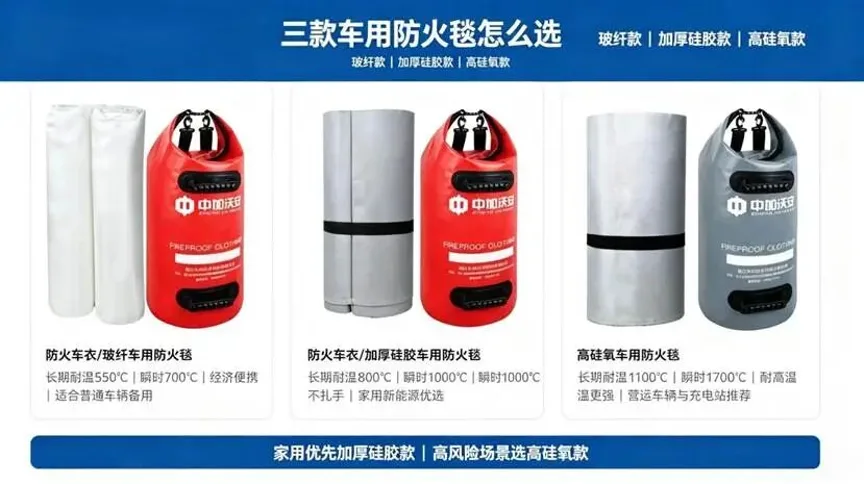
All three are full-vehicle wrap-around fire blankets (fireproof covers), mainly designed for initial thermal runaway of lithium batteries in new energy vehicles and vehicle fires. They achieve oxygen and heat insulation by completely wrapping the vehicle and all come with a dedicated carrying case, suitable for onboard storage.

1. Product Name: Fireproof Car Blanket/ Fiberglass Vehicle Fireproof Blanket

Core Material: High-density uncoated fiberglass. Temperature Resistance: Long-term temperature resistance 550℃, instantaneous temperature resistance 700℃. Packaging: Red waterproof carrying bag. Product Features and Applicable Scenarios: Basic and economical, lightweight fabric, compact size when folded, takes up little space in the trunk; uncoated fiberglass may irritate the skin upon direct contact, operation is only possible by pulling the webbing; suitable for daily emergency use in fuel vehicles and ordinary new energy vehicles, suitable for users with limited budgets.

2. Product Name: Fireproof Train Blanket/ Thickened Silicone Car Fire Blanket

Core Material: Fiberglass substrate + double-sided thickened silicone coating. Temperature Resistance: Long-term temperature resistance up to 800℃, instantaneous temperature resistance up to 1000℃. Packaging: Red waterproof carrying bag. Product Features and Applications: A mainstream preferred choice, double-sided silicone coating, preventing exposed fiberglass from being prickly; oil-resistant, waterproof, and anti-aging, resistant to cracking even after repeated folding; superior heat insulation and flame retardant properties compared to ordinary fiberglass; suitable for home use, new energy private cars, underground garages, and community parking spaces.

3. Product Name: High-Silica Automotive Fire Blanket

Core Material: High-silica special fire-resistant fiber fabric. Temperature Resistance: Long-term temperature resistance 1100℃, instantaneous temperature resistance 1700℃. Packaging: Gray waterproof handbag. Product Features and Applicable Scenarios: Highest temperature resistance rating, can withstand the high-temperature molten material ejected from lithium battery thermal runaway; thick fabric, strong protective ability; relatively heavy, larger storage volume; suitable for high-risk usage scenarios such as ride-hailing vehicles, logistics fleets, and public charging stations.

Sinowoan official website: www.zjwajt.com

Purchase Summary: For home use and new energy vehicles, prioritize thickened silicone automotive fire blankets; for those seeking portability and lightweight design, choose fiberglass automotive blankets; for commercial vehicles and charging stations, it is recommended to choose high-silica automotive fire blankets.

II. Correct Use of Vehicle Fire Blanket

https://www.xoobay.com/img/news/202609021645058137.png

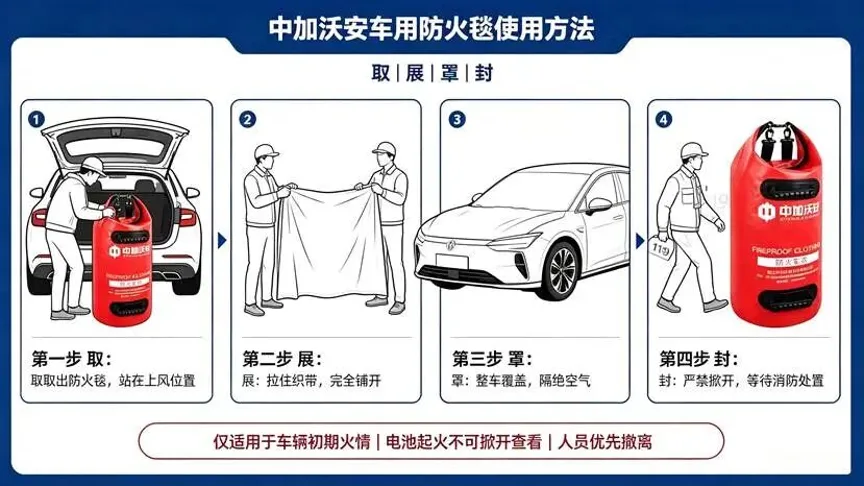
Fire Safety Knowledge: Four Steps to Using a Vehicle Fire Blanket

Step 1: Quickly take the entire fire blanket from the trunk. If possible, two people should work together, standing upwind and away from the smoke or flames coming from the vehicle.

Step 2: Hold the edge and pull the webbing to fully unfold the fire blanket. Do not touch the blanket fabric directly with your bare hands to avoid scratching or irritating your skin.

The third step is to cover the entire vehicle from the front to the rear, completely covering the entire vehicle body with a blanket to achieve oxygen isolation and flame retardancy.

Step 4: Ensure the entire vehicle is completely and securely wrapped. Do not open the wrapping to check for fire. Immediately evacuate to a safe area and call 119 to await fire rescue.

Dark blue warning bar at the bottom: Only applicable for initial vehicle fires | Never lift the blanket during a battery fire | Personal safety is paramount

III. Key Points for Use and Storage

https://www.xoobay.com/img/news/202609021645425067.png

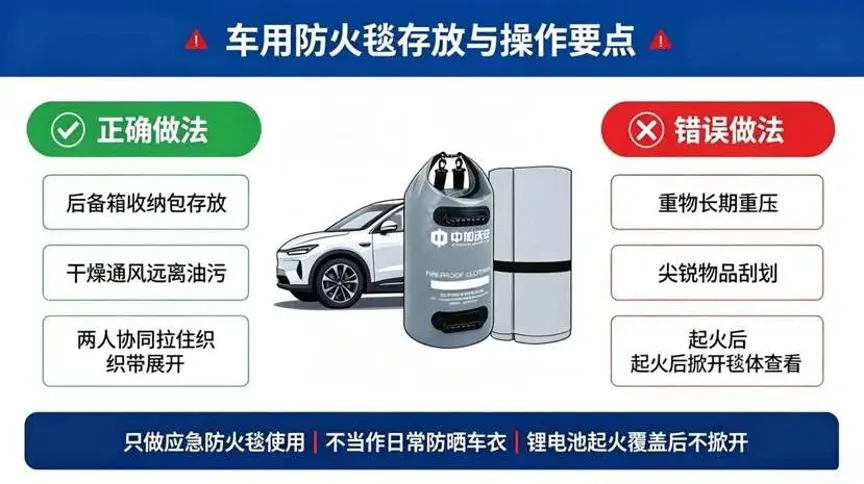
1. Storage and Management: Place the blanket in the original storage bag in the trunk of your car; keep it dry and ventilated, away from the residual heat of the high-temperature exhaust pipe and engine oil stains in the trunk; avoid sharp objects such as keys and tools puncturing the blanket; do not stack heavy objects on it for a long time to avoid causing creases and damage to the fabric.

2. When operating on-site, priority should be given to two people working together. If operating alone, pay attention to your position. After covering a lithium battery with a fire blanket, never lift the blanket, regardless of whether there is smoke, to prevent reignition and explosion that could injure people. Do not use it as a sun protection car cover for daily use on the vehicle; use it only as an emergency fire protection device.

3. Reuse criteria: Only items that have never been exposed to open flame, are free from burning, or have been scratched or damaged can be cleaned and reused. Any item that has been used to cover a vehicle that has caught fire must be scrapped immediately, regardless of whether the exterior is intact, and is prohibited from being reused.

IV. Routine Inspection and Scrapping Standards

https://www.xoobay.com/img/news/202609021646006566.png

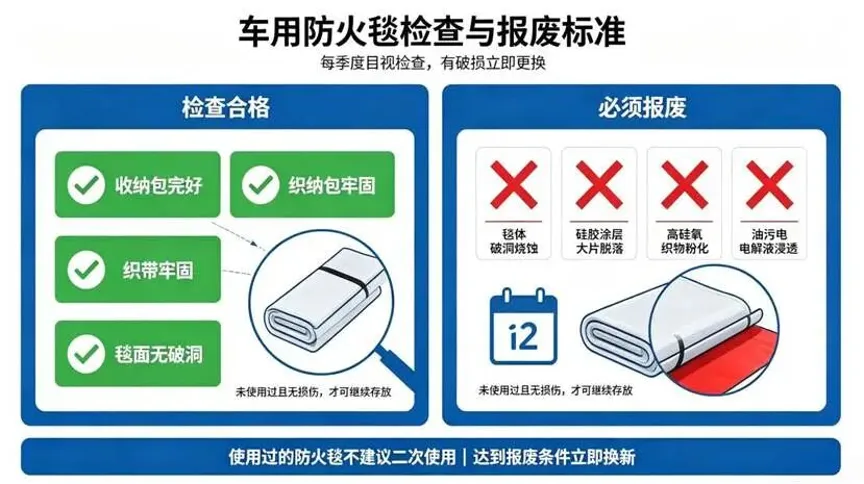
Routine checks (recommended once per quarter)

1. Storage bag: The handle straps are intact, and the bag body is free from tears or abrasions.

2. Blanket body: Partially unfolded for inspection, no tears or cuts; silicone coating has no large areas of peeling; high-silicone fabric has no powder or flaking; no large areas of oil or electrolyte staining.

3. Labels: Product model and brand logo are printed clearly and completely.

If any of these conditions are found, the item must be scrapped and replaced immediately.

1. The blanket has holes, scratches, and burn marks;

2. The silicone coating peels off over a large area, exposing the internal fiberglass substrate;

3. High-silica fabrics pulverize and crumble excessively upon contact;

4. Contaminated by electrolyte, engine oil, or chemical liquids;

5. The vehicle that caught fire has already been covered;

6. The webbing is broken or missing, making it impossible to unfold the cover properly.

Popular science tip: There is no mandatory fixed shelf life for vehicle fire blankets. The actual condition upon inspection shall prevail. If the condition reaches the end of its service life, regardless of how long ago it was purchased, it shall be replaced with a new one.

Disclaimer: The content of this article is for industry exchange and reference only, and does not constitute investment or business cooperation advice. The information is for reference only.

相关采购链接